

Meal planning for one person, without half-used bags
Recipes serve four, herbs come in big bunches and spinach comes in big bags. Cooking for one works when the plan is built around ingredient overlap, not around single recipes. Below, meal planning for one person is worked through with real recipes: three dinners with their amounts, then a week of dinners from three cooking sessions.

Short answer: Plan three or four meals that share ingredients, cook amounts you can finish or freeze, and do one short shop instead of several small ones. PantryWeave scales servings to one person, shows recipes that are Ready with what you already have, and keeps freshness checks on opened items so half-used packs get used before they go off.
The real problem is pack sizes
Cooking for one is rarely about skill. It is about arithmetic: a recipe uses a third of a pack, and the other two thirds wait in the fridge until they don’t. The answer is to plan meals that share ingredients, so every pack you open is used across the week.
Five habits for solo cooks
- Plan three dinners, not seven. Leave room for leftovers, invitations and nights you don’t feel like cooking.
- Chain ingredients. If one recipe uses half a bag of spinach, choose a second recipe that uses the rest.
- Cook once, eat twice. Make two portions of soups, stews and sauces; one for tonight, one for lunch or the freezer.
- Scale recipes down. Halve or quarter amounts and keep the method the same.
- Freeze in single portions. Cooked grains, sauces and bread freeze well in one-person amounts.
To scale a recipe down, paste its ingredient list into the recipe scaler and enter the servings in the recipe and the servings you want.
For lunch, our lunch ideas list 12 recipes from the app with their times and servings, from a 15-minute grilled cheese sandwich to soups and baked falafel.
What freezes well for one
Sliced bread (toast it from frozen), cooked rice and grains, tomato and lentil sauces, soups, grated cheese, chopped herbs in a little oil and ripe bananas for baking. Label each portion with what it is and when you froze it, and keep a short note of what is in the freezer so it gets eaten.
Freezing in individual portions helps you defrost only what you need, the UK Food Standards Agency says, so pack soups and sauces one serving to a bag or container. The USDA’s freezer chart gives soups, stews and casseroles 2 to 3 months at 0 °F (−18 °C), and FoodKeeper, the USDA’s storage app, gives store-bought bread 3 to 5 months from the date of purchase and bananas 2 to 3 months. The USDA notes that freezer times are for quality. For wrapping, thawing and the full chart, see our guide on how to freeze food and avoid freezer burn.
Sources: USDA FSIS: freezing and the freezer storage chart, read on October 30, 2026, and the USDA FoodKeeper app (FoodKeeper data file, version 128, as archived on July 2, 2025; read on November 18, 2026); Food Standards Agency: how to chill, freeze and defrost food, read on November 2, 2026.
A small pantry for one
A short list of long-life staples makes solo cooking far easier: rice or another grain, pasta, a tin of tomatoes, a tin of chickpeas or beans, eggs, an onion, garlic, a hard cheese and frozen peas. With these at home, two or three fresh ingredients are enough for most dinners.
Buy fresh ingredients for the plan, not for a single recipe. A bunch of coriander bought for one curry is a bunch of coriander you need to use in two more meals.
A grocery list for one: buy what you will use up
A grocery list for one has two jobs: buy the amounts your planned meals use, and leave out what is already at home. Our guide to a grocery list with only what’s missing covers the second job. For the first, a few habits help in the shop:
- Pick loose produce. Loose onions, carrots, apples and peppers let you take home just as many as your meals call for.
- Ask at the counter. At the meat, fish or cheese counter, ask for the amount you need rather than a pre-packed tray.
- Keep a few frozen staples. With frozen peas, spinach or berries you take out one portion at a time and leave the rest in the freezer.
- Portion big packs at home. When an ingredient only comes in a large pack, divide it into single portions, wrap each one and freeze the ones you will cook later.
With PantryWeave, plan your meals ahead, day by day, and get a shopping list with only what is missing from your Kitchen.
A meal plan for one person: three dinners, one shopping list
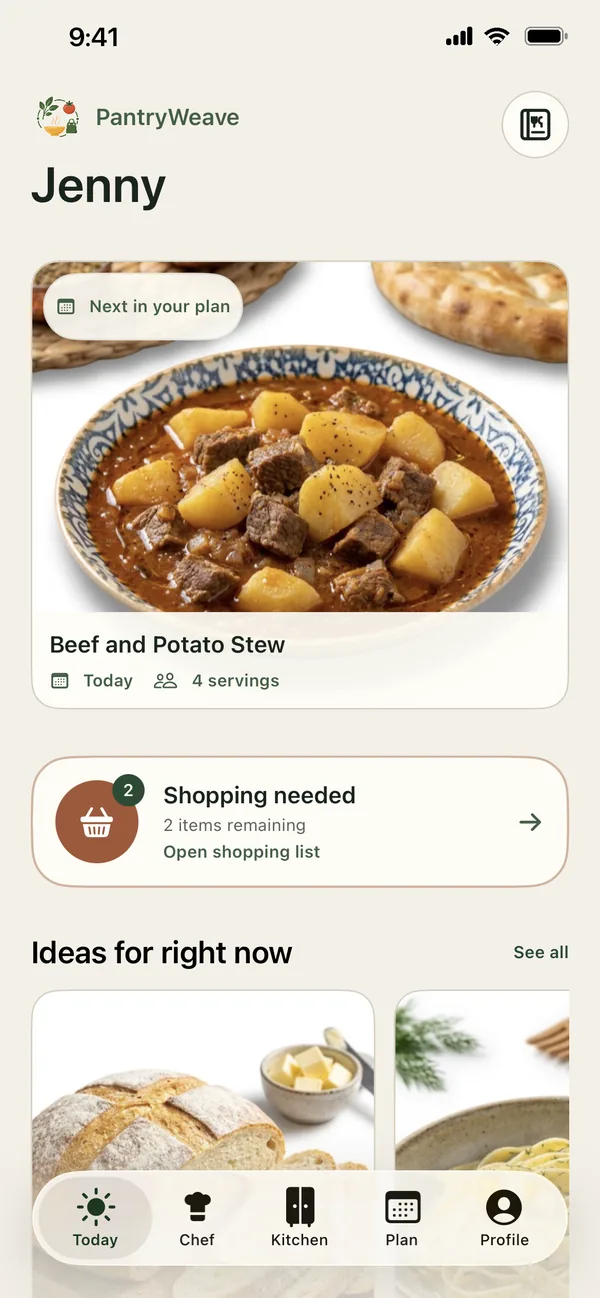
Most recipes are written for more than one person. Our beef and potato stew and chickpea stew with beef serve four, and the cauliflower stew with minced meat serves three. Scaled to one serving each, the three dinners need the amounts below.
| Ingredient | One serving of each dinner | Together |
|---|---|---|
| Onion | ¼ (beef and potato stew), ¼ (chickpea stew), ⅓ (cauliflower stew) | ⅚, so one onion covers all three |
| Beef | 100 g (beef and potato stew), 87.5 g (chickpea stew) | 187.5 g |
| Potato | ½ (beef and potato stew) | ½ |
| Dried chickpeas | 75 ml, soaked overnight (chickpea stew) | 75 ml |
| Cauliflower | ⅙ of a head (cauliflower stew) | ⅙ of a head |
| Carrot | ⅔ (cauliflower stew) | ⅔ |
| Ground meat | about 33 g (cauliflower stew) | about 33 g |
Each amount is the recipe’s own ingredient amount divided by its number of servings. Olive oil, red pepper paste, tomato paste, salt and spices come from the pantry.
One onion covers all three dinners, and the beef for two of them comes to about 190 g, an amount to ask for at the counter. The cauliflower stew is the one that does not scale down well: a single serving uses a sixth of a cauliflower and about 33 g of ground meat. It is easier to cook in full, with half a cauliflower, two carrots, one onion and 100 g of ground meat for its three servings. Eat one portion and freeze the other two separately, one portion to a container. Cooked this way, the three dinners use one and a half onions, so buy two instead of one.
In PantryWeave, use the Servings stepper on a recipe to raise or lower the servings.
Meal prep for one: a week of dinners from three cooking nights
For meal prep for one, cook each recipe in full, eat it that night and the next, and freeze the other portions one to a container: three cooking nights then cover seven dinners and leave portions for the week after.
The two-night rhythm follows the UK Food Standards Agency’s student guide, which says: “Food that has been adequately cooled down within 1 to 2 hours should be stored in the fridge and consumed within two days. If you cook more portions than you can eat in two days, freeze any extra portions.”
Here are the same three stews from the example above, each cooked as its recipe is written.
| Day | Dinner | What to do |
|---|---|---|
| Monday | Beef and potato stew, cooked tonight (four servings) | Eat one, keep one in the fridge for Tuesday and freeze two |
| Tuesday | Beef and potato stew from the fridge | Put the dried chickpeas in water to soak overnight |
| Wednesday | Chickpea stew with beef, cooked tonight (four servings) | Eat one, keep one for Thursday and freeze two |
| Thursday | Chickpea stew from the fridge | Nothing to cook |
| Friday | Cauliflower stew with minced meat, cooked tonight (three servings) | Eat one, keep one for Saturday and freeze one |
| Saturday | Cauliflower stew from the fridge | Nothing to cook |
| Sunday | Beef and potato stew from the freezer | Four portions wait in the freezer for next week: one beef and potato stew, two chickpea stews and one cauliflower stew |
From the three recipes’ own ingredient lists, the week’s shopping comes to three onions, 750 g of beef, two potatoes, 300 ml of dried chickpeas, half a cauliflower, two carrots and 100 g of ground meat. The pantry covers the rest: olive oil, the two pastes, salt and spices.
In PantryWeave, put the three cooking nights on the days of your week in Plan; the shopping list adds up what the three recipes need and takes away what Kitchen already holds. For more batch recipes and the fridge time of each one, see our meal prep ideas.
Source: Food Standards Agency: student guide, bulk cooking section, read on November 20, 2026.
One bag of spinach, three meals
Each dinner finishes something the last one opened.
| Meal | Uses | Leaves you with |
|---|---|---|
| Mon · Spinach and chickpea curry | ½ bag spinach, 1 can chickpeas | Rice for Wednesday |
| Tue · Spinach and feta omelette | Rest of the spinach, 2 eggs, feta | Half the feta |
| Wed · Rice bowl with roast vegetables and feta | Leftover rice, the rest of the feta | An empty fridge shelf |
Plan meals for one from your fridge
How do you meal plan for one in college?
To meal plan for one in college, plan a few dinners around the fridge space you actually have, cook one of them in bulk, and buy only the food those dinners will use.
Space is the first limit. The UK Food Standards Agency’s student guide notes that at university “you may only have access to one shelf in a shared fridge”, and on shopping it says to “aim to buy foods that you know you will eat (or freeze for later use) within the use by and best before dates.”
Keep the fresh part of the week small enough for that shelf: fresh ingredients for the first two or three dinners, then dinners built on rice, pasta, tins and the frozen portions from your bulk cook. For a shelf you share, the same guide says: “It may help to put any opened raw meat or fish into separate containers that are sealed or waterproof.”
In PantryWeave, add what is on your shelf and in your cupboard to Kitchen, and the question of what to cook tonight starts from there. In Chef, the app’s recipe finder, How much shopping? sets how far the suggestions go beyond that food, from Nothing extra through Short shopping to Flexible shopping, and How much time? keeps them to 15, 30 or 45 minutes on an evening with a late class.
Source: Food Standards Agency: student guide, sections “Food hygiene in a shared fridge” and “Bulk cooking”, read on November 22, 2026.
Cooking for two
A meal plan for two works the same way, and pack sizes fit a little better. Three habits matter most:
- Plan meals in pairs. A pack of chicken thighs or a bag of spinach usually covers two dinners for two. Put them on consecutive days so nothing waits too long.
- Cook once, eat twice. A pot of chili or soup for four is two dinners for two: one tonight, one later in the week or from the freezer.
- Fresh first, staples last. Plan the meals with herbs and salad leaves early in the week and the ones built on pantry staples at the end.
Dishes cooked in a pan halve easily; traybakes and bakes are simpler to make in full and freeze half.
For a whole week planned this way, our meal plan for two sets out seven dinners from our recipes, each one written for two people.
How PantryWeave helps
If you cook for one, PantryWeave, the weekly meal planner for iPhone, which also runs on iPad, plans your week around what’s in your fridge.
Kitchen keeps the food in your fridge, freezer and pantry, and Use first lifts the items that need eating soon to the top. Chef suggests dinners that use what you have, suit the profile you pick under Who is eating? (your allergens, your diet and the ingredients you avoid) and match the kitchen equipment you saved. If two recipes fit you equally, Chef puts first the one that uses food near its date. You set the dinners on the days of your week in Plan, and the shopping list carries only what is still missing.
Servings that fit
Use the Servings stepper to raise or lower the servings.
A plan that fits one
Build a plan for the days ahead. Every recipe follows your own profile, and the meals reserve what they need from your Kitchen.
Nothing extra
Pick Nothing extra to see recipes that are ready with what you already have.
Keep your favourites
Save the recipes that work for you and cook them again whenever the week calls for it.
Calories per serving
Every recipe lists estimated calories, carbohydrates, fat and protein per serving, so you plan your meals with the calories in view.
Plan meals for one from your fridge
A meal planner app for one that starts from your fridge
Scale every recipe to one serving, plan three or four dinners around what is already open, and shop only for what is missing.
Still comparing apps? Here is what to look for in a meal planning app.
Frequently asked questions
Can I scale recipes down to one serving?
Yes. Use the Servings stepper on a recipe to raise or lower the servings.
Is PantryWeave useful if I live alone?
Yes. You can use a single profile with your own allergies, diet and dislikes, and plan a few evenings at a time.
Do I need to track every ingredient?
No. Add the ingredients that decide dinner. If you only know an ingredient is at home, you can add it to Kitchen and leave the amount empty. Set an amount when you want PantryWeave to calculate how much is available for a planned meal or to deduct it from Kitchen after cooking.
Are there meal plans for one person?
Yes. This guide includes two you can follow: three dinners scaled to a single serving, with the amounts of their main ingredients, and a week of seven dinners cooked on three nights.
How do you meal plan for one on a budget?
Cook one dish in bulk and portion it out. The UK Food Standards Agency’s student guide says: “A cost effective way to manage your food and budget can be to bulk cook one dish and separate it out into different containers to eat throughout the week.” Pick loose produce in the amounts your dinners use, and for a full week on a budget, see our cheap meal plan.
What does a weekly meal plan for one person look like?
A weekly meal plan for one person can be seven dinners from three cooking nights. Monday, Wednesday and Friday are the nights you cook, one stew each, and every stew is eaten that night and the next; Sunday’s dinner is a portion taken from the freezer. The meal prep section above names the three recipes and lists every day and the week’s shopping.
Related guides

Cook for one, use everything
Download PantryWeave on the App Store and plan your first week from what you already have.

Free to start · iPhone