
Meal planning: how to plan meals, step by step
Meal planning comes down to a few decisions made before you shop: how many meals, which ones, on which days, and what to buy. Two US extension services publish step lists; here they are in one order, with advice from Harvard’s Nutrition Source and a tip from Utah State.

Short answer: count the meals you need until your next shopping trip, check what is already in the fridge, freezer and cupboard, choose meals that use it, give each meal a day, plan what to do with leftovers, add sides and snacks, then write a grocery list for the rest. The order combines the steps of Virginia Cooperative Extension and Iowa State University Extension and Outreach.
How to meal plan, step by step
Virginia Cooperative Extension (Eat Smart, Move More) gives seven steps and Iowa State University Extension and Outreach (Spend Smart Eat Smart) gives six. They overlap; this is the combined order.
- Decide how many meals to plan. Virginia Cooperative Extension starts by counting the meals you need until your next shopping trip, so you do not run out of meal ideas before you shop again. For a first try, The Nutrition Source at the Harvard T.H. Chan School of Public Health says: “Start small: Aim to create enough dinners for 2-3 days of the week.” Utah State University Extension’s planner says: “New to meal planning? Consider just making a dinner or lunch menu.”
- Check what you already have. Both extension services put this near the start, before you buy anything. Virginia Cooperative Extension says to check the fridge and pantry. Iowa State University Extension and Outreach adds the freezer and the cupboard, has you write those foods down under “on hand”, and crosses them off as you use them.
- Choose meals around what you have and what is on sale. Iowa State University Extension and Outreach starts from the on-hand foods and then looks at the store’s specials; Virginia Cooperative Extension looks at the sales first and then picks recipes. Its example: “Is chicken on sale at your grocery store this week? Plan meals around sale foods.” As its fifth step, Iowa State University Extension and Outreach suggests a check: “Review your meals and see if there is something from each of the food groups in most of your meals.”
- Give each meal a day. Virginia Cooperative Extension says: “Items that will spoil quickly, like fish or fresh produce, should be eaten earlier in the week.” It also puts the quickest meals on your busiest days. Iowa State’s worksheet leaves the days blank, so the order can change during the week.
- Plan for leftovers. Iowa State suggests working a big dish into a later meal in the same week. Harvard’s Nutrition Source suggests cooking extra portions for another day or for the freezer, with a date on each container. How long they keep: How long are leftovers good for?
- Add sides and snacks. Virginia Cooperative Extension reminds you to plan side dishes and snacks along with the main meals, including grab-and-go snacks for the time of day you usually get hungry.
- Write the grocery list. List what the plan needs and you do not have, and take the list with you. Virginia Cooperative Extension says: “Sticking to your list while you shop will help you avoid buying items you don’t need.”
The steps side by side: Virginia, Iowa State and PantryWeave
Where each step sits in the two extension guides, and where you do it in PantryWeave.
| Step | Virginia | Iowa State | PantryWeave |
|---|---|---|---|
| How many meals | Step 1: count the meals until the next shopping trip | Step 1: look at the next five days; note quick meals, company meals or slow cooker days | The weekly plan, with each day split into its meals |
| What you have | Step 2: check the fridge and pantry | Step 2: check the fridge, freezer and cupboard; write the foods under “on hand” | Kitchen keeps the fridge, freezer and pantry; Use first lists what to eat soon |
| Choosing meals | Steps 3 and 4: sale items, then recipes from what you have | Steps 3 to 5: ideas for the on-hand foods, the store’s specials, then a food group check | Chef suggests dishes from what Kitchen holds, for the people picked under Who is eating? and your saved equipment |
| Days | Step 5: food that spoils quickly early in the week; quick meals on busy days | Step 1: no days on the worksheet, so meals can swap places | You pick the day and the meal slot for each dish |
| Leftovers | Not one of its steps | Step 4: work a big dish into a later meal | — |
| Sides and snacks | Step 6: sides and snacks go on the plan | Step 3: spaces for breakfast, lunch, snacks and dinner | Chef has separate starting points for breakfast, lunch, dinner, sides, snacks and desserts |
| Grocery list | Step 7: make the list and keep to it | Step 3: add what you need to buy to the list | The list is made from the plan, minus what Kitchen has |
A planning day, theme nights and a monthly plan
The Nutrition Source at the Harvard T.H. Chan School of Public Health splits the work into separate jobs: planning the menu and writing the grocery list, shopping, and doing most of the cooking ahead. It suggests a set day of the week for each, and a menu planned either week by week or for the whole month.
For the month view it suggests: “Start a monthly calendar or spreadsheet to record your meal ideas, favorite recipe sites, and food shopping lists.”
On theme nights it says: “Some families enjoy the consistency of knowing what to expect, and it can help to ease your meal planning. Examples are Meatless Mondays, Whole Grain Wednesdays, Stir-Fry Fridays, etc.”
Splitting meal planning and preparation across separate days, as Harvard describes, leaves the cooking for prep day. Our meal prep ideas show what to cook ahead and give storage times where the sources provide them. For batches built around protein, see high protein meal prep.
Grocery shopping around the plan
Iowa State University Extension and Outreach notes where to find the week’s specials: “If you don’t get the grocery ads in the newspaper, you can download them from the store’s website or app.” It also ties the shopping back to the next plan: “If you have extra money and there are good specials on items your family uses regularly, try to stock up. If you continue to plan using this method, these bargains will be put to good use as part of your ‘on hand’ list.”
The Nutrition Source at the Harvard T.H. Chan School of Public Health suggests what is worth stocking up on once your menus settle into a pattern: “watch for sales and coupons to stock up on frequently used shelf-stable ingredients like pasta, rice, and other whole grains, lentils, beans (canned or dried), jarred sauces, healthy oils, and spices.”
Writing the list and keeping to it in the store are covered in Family grocery list: how to make one. For how PantryWeave builds its list from the week’s plan, see our grocery list app guide.
Plan your week
Our guides for each kind of plan:
- Weekly meal planner: plan your entire week in minutes
- Weekly meal planner template: a printable meal plan sheet
- Family meal plans: one weekly plan that works for everyone at your table
- Meal planning for one person, without half-used bags
- Meal plan for two: seven dinners for a week
- Family grocery list: how to make one
- How to choose a meal planning app
A meal planning app that follows the same steps
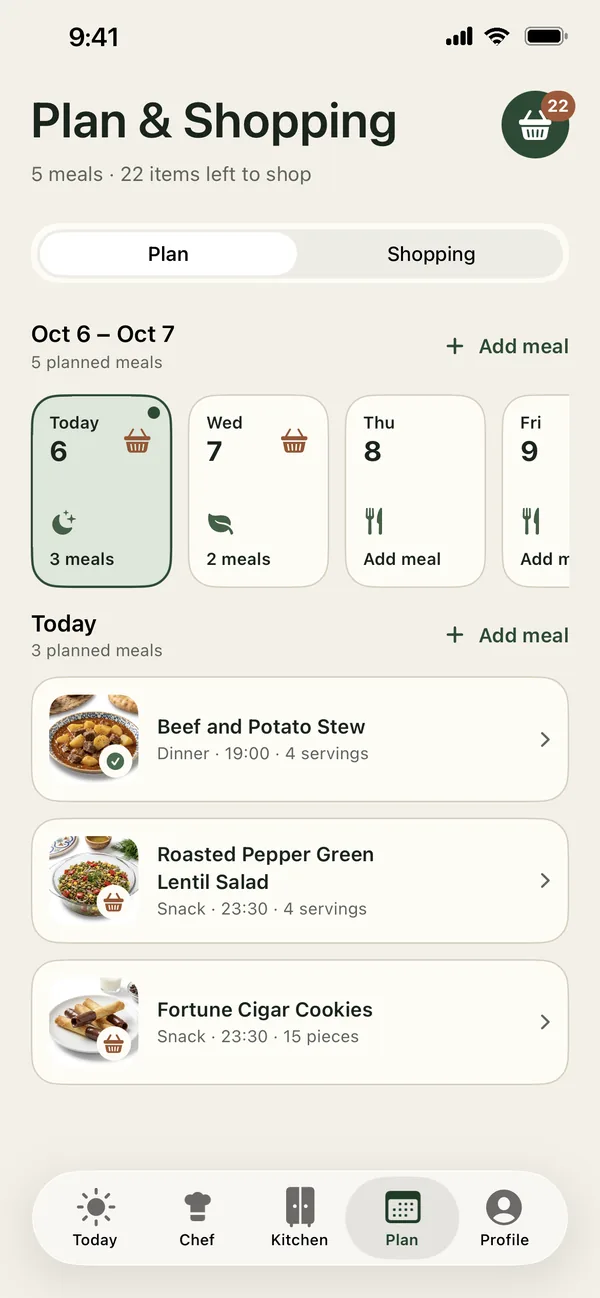
PantryWeave, the weekly meal planner for iPhone, which also runs on iPad, puts these steps in one place: you lay out the week on the plan, and Kitchen, Chef and the shopping list cover the steps around it.
Check what you have
Kitchen is the app’s inventory: it lists the food sitting in your fridge, freezer and pantry. Its Use first section sits at the top and brings forward the food to eat soon, so it can go into the first days of the plan.
Pick the recipes
You give each person you cook for a profile that lists their allergens, diet and foods to avoid. In Chef, the recipe finder, you tick who is at the meal under Who is eating?; it then suggests dishes that fit those people, the kitchen equipment you saved and what Kitchen already holds.
Lay out the week
You decide which dishes go where on the weekly plan, day by day and meal by meal. Once a meal is on the plan, Kitchen holds back its ingredients for that meal until you cook it or drop it from the week.
Shop for the gap
The shopping list comes straight out of the plan: it adds up what the meals need, takes away what Kitchen has, and keeps only the missing items. At the store you tick what you bought and move it into Kitchen.
Allergies. When a shopping list item concerns someone’s allergy or diet, an icon appears next to it; tapping the icon shows whose, and the note ends with: “Check the label and ingredient list of the product you buy.”
Where the steps come from
- Virginia Cooperative Extension, Eat Smart, Move More: Meal Planning (seven steps; read on November 19, 2026)
- Iowa State University Extension and Outreach, Spend Smart Eat Smart: Menu Planning (six steps and the five day worksheet; read on November 19, 2026)
- The Nutrition Source, Harvard T.H. Chan School of Public Health: Meal Prep Guide (where to start, the planning day, leftovers; read on November 19, 2026)
- Utah State University Extension: Weekly Menu Planner (planning tips; read on November 19, 2026)
Frequently asked questions
What is meal planning?
Meal planning means deciding, before you shop, which meals you will eat over the coming days, then buying what those meals need. Virginia Cooperative Extension’s last step is: “Create your grocery list. After you’ve figured out your meal plan, put a list together of all the items you need at the store.”
What is the difference between meal prep and meal planning?
In this guide, planning means deciding the menu and writing the grocery list, and meal prep means the cooking you do ahead. The Nutrition Source at the Harvard T.H. Chan School of Public Health uses the two terms together; what it splits up is the work, with a day for each job: “Choose a specific day of the week to: 1) plan the menu, whether week by week or for the whole month, and write out your grocery list 2) food shop, 3) do meal prep, or most of your cooking.”
Why plan meals?
Virginia Cooperative Extension says: “Meal planning helps you save time, money and extra trips to the grocery store. It also helps you stick to your food budget and helps you buy only what you need for the week.”
How do you start meal planning?
Plan a few dinners rather than a full week. The Nutrition Source at the Harvard T.H. Chan School of Public Health suggests enough dinners for two or three days to begin with. Utah State University Extension’s planner suggests that newcomers make just a dinner or a lunch menu.
How do you make meal planning easy?
Virginia Cooperative Extension says: “Are there days that require quicker meals than others? If so, plan quick and easy meals on your busiest days and save the more time-consuming ones for slower days.” Iowa State University Extension and Outreach says: “You’ll notice that the planner does not include days of the week. This allows you to be flexible and switch the order of your meals throughout the week.”
Can you do meal planning for free?
Yes. Iowa State University Extension and Outreach says: “Print a copy of the five day meal planning worksheet in English or Spanish.” Its five day meal planning worksheet is linked from its menu planning page, and our printable weekly meal planner template is a single sheet for the week.
How do you plan meals around what you already have?
Virginia Cooperative Extension says: “Check your fridge and pantry for ingredients. There’s no need to buy foods you already have.” Iowa State University Extension and Outreach says: “Check what you have on hand. Check the refrigerator, freezer, and cupboard for foods that need to be used up.”
How do you plan meals for leftovers?
Iowa State University Extension and Outreach says: “It is a smart idea to plan for leftovers. For example, if you are making a big pot of spaghetti on Monday, work it into your menu plan later in the week to be sure it doesn’t go to waste.” The Nutrition Source at the Harvard T.H. Chan School of Public Health says: “When you cook a recipe, make extra portions for another day or two of meals, or to freeze for a different week. Be sure to date and label what goes in the freezer so you know what you have on hand.”
Related guides

Plan next week’s meals in PantryWeave
PantryWeave, the weekly meal planner for iPhone, which also runs on iPad, is free to start.

Free to start · iPhone