

Cheap meal plan: how to plan a week of meals on a budget
A cheap meal plan is decided before you shop: it starts from the food already in your kitchen, leans on what is on sale, cooks some dishes big enough for a second meal and ends with a list you keep to. Below are the budget steps US extension services publish, side by side, a sample week of dinners from our recipe catalog and what institutions publish about food costs.

Short answer: use what is already in your kitchen first (Purdue and Minnesota put this before the store, Iowa State makes it its second step and Alabama does it while writing the list), plan around sales (Iowa State, Minnesota, Alabama) and seasonal food (Alabama, Purdue, Minnesota), lean on eggs, rice and pasta (Purdue), put quick dishes on your busiest days (Purdue, Iowa State), plan where the leftovers go (Minnesota, Iowa State), then shop from a list with fewer trips (Minnesota, Alabama, Purdue).
How to make a cheap meal plan, step by step
Four extension services publish budget meal planning advice: Iowa State University Extension and Outreach (Spend Smart Eat Smart, in numbered steps), Purdue Extension, University of Minnesota Extension and the Alabama Cooperative Extension System. Their advice overlaps; this is one order that follows the week from the kitchen shelf to the checkout.
- Shop your own kitchen first. Iowa State, Purdue, Minnesota and Alabama all send you to your own shelves before the shopping trip. Purdue Extension says: “Before heading to the grocery store, get organized. Look in your freezer, cabinets and refrigerator. See what items you already have and save money by using them.” Iowa State University Extension and Outreach has you write those foods on the planner under “on hand” and cross them off as they are used.
- Plan around what is on sale and in season. Iowa State University Extension and Outreach says: “As you spot items that are on sale, work them into your menus for the week.” Alabama Cooperative Extension System says: “Plan your meals to use seasonal foods such as oranges in the winter and peaches in the summer.”
- Build meals on the staples Purdue names. Purdue Extension says: “Don’t forget about eggs! They’re a great low-cost option that’s easy to prepare.” It also says: “Choose rice and pasta for budget-friendly grain options.” For meat, Purdue suggests the family-sized or value pack, with what you do not use going into the freezer.
- Match the cooking to your week. Purdue Extension says: “Think about your schedule. Choose meals you can make easily on your busiest days. Save recipes that take longer for your days off.”
- Plan the leftovers, not just the meals. University of Minnesota Extension says: “Plan the use of leftovers. They can be used in casseroles, soups, for snacks, and in lunch boxes.” Iowa State gives the example of a big pot of spaghetti on Monday worked into a later meal the same week.
- Write the list, and shop once. University of Minnesota Extension says: “One way to control spending and avoid impulse buying is to make a list of the items needed.” Alabama Cooperative Extension System says: “Make fewer trips to the store. The more trips to the store, the more money you spend.”
- Compare prices at the shelf. Alabama Cooperative Extension System describes the unit price as the cost per ounce or per pound. Iowa State University Extension and Outreach’s carrot example: one pound of baby carrots at $0.99, two pounds at $1.89 ($0.94 per pound), and one pound of full-sized carrots at $0.68, which it calls the best buy; Iowa State adds that buying them saves money if you have time to peel and cut them that week. Alabama Cooperative Extension System says: “Know the regular prices of items you usually buy. A sale will then be easy to spot.”
The budget steps side by side: Iowa State, the other extensions and PantryWeave
Where each step appears in Iowa State’s menu planning steps, what the other extension guides add, and where the same step happens in PantryWeave. On a phone, scroll the table sideways for the last columns.
| Step | Iowa State | Other extensions | PantryWeave |
|---|---|---|---|
| Start at home | Write the fridge, freezer and cupboard foods under “on hand” | Purdue: freezer, cabinets and refrigerator before the store; Minnesota: cupboards, refrigerator and freezer while writing the list | Kitchen records the contents of each storage place, and Use first gathers the food to eat soon |
| Sales and seasons | Work sale items into the week’s menus | Alabama: plan around seasonal foods and know regular prices | Put what you bought on sale into Kitchen; Chef suggests dishes from what Kitchen holds |
| Busy days | Note quick meals, company meals and slow cooker days on the planner | Purdue: easy meals on busy days, longer recipes on days off | Chef has a How much time? filter; you choose the day and meal slot on the plan |
| Leftovers | Work a big dish into a later meal the same week | Minnesota: casseroles, soups, snacks and lunch boxes; New Hampshire: one lunch dish used again on a later day | — |
| The list | Add what the meals still need to the grocery list | Minnesota: list the items needed; Alabama: fewer trips to the store | The shopping list comes from the planned dishes, less what Kitchen already holds |
Cheap meal prep: cook once, eat twice
Cooking once for two meals is the meal prep side of a budget week. University of New Hampshire Extension builds this into its Low Cost Menu Planner, a sample week in which a dish made for one lunch returns on a later day; its note on Monday reads: “make the Picnic Potato Salad, use it for lunch today and for lunch on day 4”.
For food you will not eat that week, Purdue Extension says: “Save some for later. Freeze leftover soups, sauces or gravies in small reusable containers.” For how many days cooked food keeps in the fridge, see How long are leftovers good for?
A sample week of dinners that follows these steps
Six recipes from the PantryWeave recipe catalog and one planned leftover night. Time and servings are the catalog’s; we do not price the dishes, because prices change by store and by week. On a phone, scroll the table sideways for the last column.
| Day | Dinner | Catalog time and servings | The step it follows |
|---|---|---|---|
| Monday | Cowboy Chili | 60 min · 6 servings | A big pot cooked once; what is left is Wednesday’s dinner |
| Tuesday | Chickpea Salad with Harissa | 10 min · 6 servings | The quickest dish of the week, for the busiest day; the rest goes into lunch boxes |
| Wednesday | Cowboy Chili, second night | reheated | The planned leftover from Monday |
| Thursday | Baked Chicken Drumsticks | 45 min · 4 servings | Drumsticks from a family pack; the rest of the pack goes in the freezer |
| Friday | Lentil Soup | 35 min · 8 bowls | More soup than one dinner needs; extra bowls go in the freezer for another week |
| Saturday | Beef Doner over Rice | 40 min · 4 servings | Served over rice, one of the grains Purdue names; the meat is shaped and frozen the day before, so start it on Friday |
| Sunday | Baked Falafel with Tahini Sauce | 55 min · 4 servings | Chickpeas again: canned for Tuesday’s salad, dried and soaked ahead for the falafel |
What does a cheap meal plan cost?
It depends on who is eating and where you shop, so the published figures are worth reading with their dates. The U.S. Department of Veterans Affairs’ Thrifty Meal Plan handout, dated March 2020, prices one sample day of meals (one cup of cooked oatmeal at breakfast, two fish tacos at dinner) at $5.63.
Iowa State University Extension and Outreach has a grocery budget calculator based on USDA’s Low-Cost Food Plan for the latest month available. It starts from a cost for each person by age and gender, if they ate all their meals at home, and Iowa State’s calculator then takes off 1/21 of that cost for each meal eaten away from home.
Iowa State’s calculator also adjusts for household size: it adds 20 percent for one person, 10 percent for two and 5 percent for three, makes no change for four, and subtracts 5 percent for five or six people and 10 percent for seven or more. Restaurant meals and school meals are not part of its estimate. For a current figure for your own household, enter each person in Iowa State’s grocery budget calculator.
Plan the rest of your week
Our guides for the next steps:
- Meal planning: how to plan meals, step by step
- Weekly meal planner: plan your entire week in minutes
- Weekly meal planner template: a printable meal plan sheet
- Family grocery list: how to make one
- A grocery list with only what’s missing
- Your pantry already has tonight's dinner
- Vegan meal planner: a week from what you already have
- Vegan Meal Prep Ideas: 14 Recipes That Make 4 or More Servings
Plan from what you already have, in PantryWeave
PantryWeave, the weekly meal planner for iPhone, which also runs on iPad, works in the same order: look at what is at home, choose the week’s dishes, then buy only the gap.
Start from your shelves
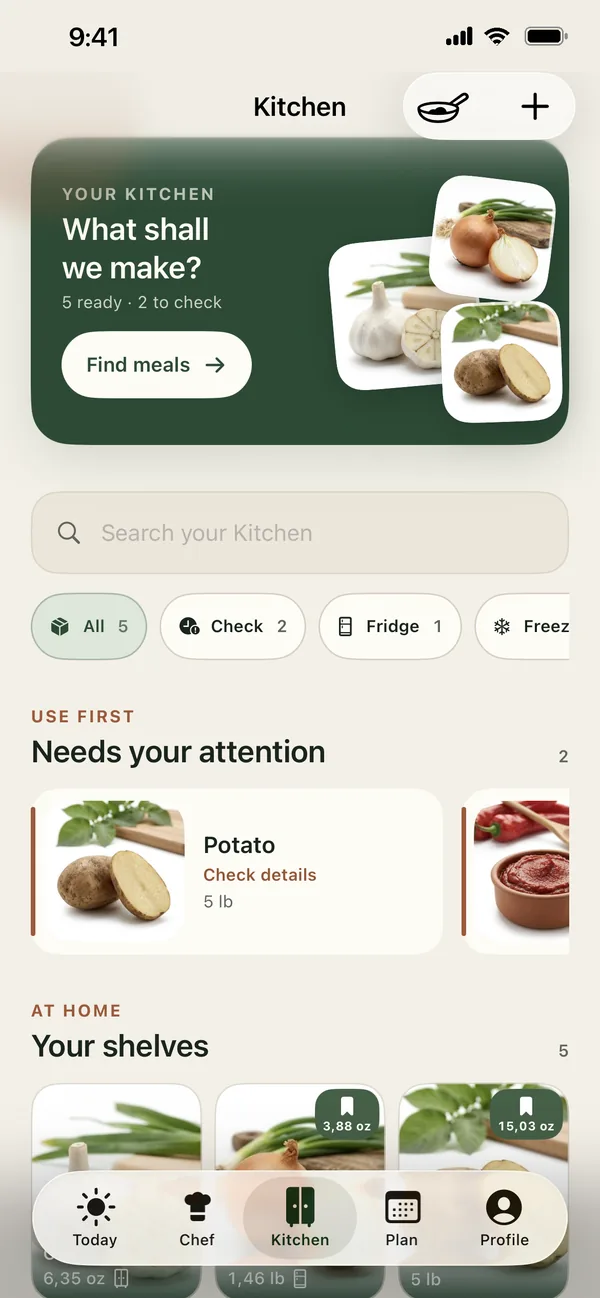
Kitchen lists what you keep in the fridge, freezer and pantry. The Use first section at the top holds the food that needs eating soon, so the first nights of the week can be built around it.
Cook with what is there
Chef, the recipe finder, has a How much shopping? filter: choose Nothing extra and it suggests dishes you can make from what Kitchen holds. Tick the people at the table under Who is eating? and the suggestions also respect each person’s profile of allergens, diet and foods to avoid, and the kitchen equipment you saved. Servings go up or down to match the table.
Put dishes on days
You choose the dishes and give each one a day and a meal slot in the weekly plan. Once a dish is planned, Kitchen keeps its ingredients aside for it until it is cooked or removed from the week.
Buy only what is missing
The shopping list totals what the planned dishes need, takes off what Kitchen already has and leaves only the missing amounts; drop a dish from the plan and the list changes with it. In the store you tick each item as bought and move it into Kitchen.
Allergies. Tap a shopping list item that touches someone’s allergy or food choice to see whose it is; the note ends with: “Check the label and ingredient list of the product you buy.”
Where the steps and figures come from
- Iowa State University Extension and Outreach, Spend Smart Eat Smart: Menu Planning, with its pages on what you spend, tracking food expenses and unit pricing (read on November 20, 2026)
- Purdue Extension, Nutrition Education Program: Eating Healthy on a Budget (read on November 20, 2026)
- University of Minnesota Extension: What to eat when money is tight (read on November 20, 2026)
- Alabama Cooperative Extension System: Ways to Save Your Food Dollars (read on November 20, 2026)
- University of New Hampshire Extension: Low Cost Menu Planner (read on November 20, 2026)
- U.S. Department of Veterans Affairs, Nutrition and Food Services: Thrifty Meal Plan (handout dated March 2020; read on November 20, 2026)
Frequently asked questions
How does a meal plan keep grocery spending down?
University of Minnesota Extension says: “Before dashing out to the grocery store, it's important to shop your cupboards and take the time to plan meals and make a shopping list. By doing so, you are more likely to find the best buys, avoid impulse purchases, and eliminate extra trips for forgotten items.” For why to plan meals at all, see Meal planning: how to plan meals, step by step.
How do you keep a meal plan within a food budget?
Iowa State University Extension and Outreach suggests that each person in the family keeps every food receipt for a month, sorted by where the food was bought, and says: “It is OK to start small and make one change each month. In time, the change will add up to big savings.”
Are store brands cheaper?
University of Minnesota Extension says: “Compare national brand and store brand products. Store brand products can best be identified by their plain, simple packaging. These products are usually less expensive.” Alabama Cooperative Extension System says: “In place of national brands, buy store brands when the taste and quality suit your needs.”
Are frozen and canned vegetables cheaper than fresh?
Purdue Extension says: “If you have the freezer space, buy frozen vegetables without added sauces or butter. They’re as good for you as fresh and may cost less.” It also says: “Use canned and frozen fruits and vegetables. They last much longer than fresh and are a quick way to add fruits and vegetables to your meal.”
Can a cheap meal plan be healthy?
Purdue Extension says: “Eating healthy doesn’t have to be expensive.” University of Minnesota Extension says: “Healthy foods give you more value for your dollar.” Iowa State University Extension and Outreach says: “Review your meals and see if there is something from each of the food groups in most of your meals. This is the simplest way to make sure your meals are healthy.” For healthy meal planning from what you have at home, see our healthy meal planning guide.
Can you make a cheap meal plan for one or two people?
Yes; the steps are the same, and the difference is portion size and what you do with the extra servings. Our guides cover meal planning for one person and a week of dinners for two.
Related guides

Plan next week from your own shelves
Start free with PantryWeave, the weekly meal planner for iPhone, which also runs on iPad.

Free to start · iPhone