
How to reduce food waste at home
Eight steps from US and UK government guidance, from checking what you have to using leftovers in time, each with a guide for the details.

Short answer: Look in your fridge, freezer and pantry before you shop, plan the week’s meals around what needs using up, and buy only what those meals still need. At home, store food where it keeps best, freeze what you won’t eat in time, read date labels for what they mean, cook the right amount and eat leftovers within the time limits. Each step below comes from US guidance (EPA, FDA, USDA) or UK guidance (Food Standards Agency).
Eight steps to waste less food
- Check what you already have. Look in your fridge, freezer and pantry before you shop, so you don’t buy food you already have, and list each week what needs using up, the EPA suggests. How to keep a kitchen inventory.
- Plan meals around what needs using up. Plan the week’s meals before you go shopping and buy only what those meals need (EPA). Start with the ingredients that won’t keep, as in use food first, then fill the rest of the week; a printable meal planner helps.
- Buy only what is missing, in the right amounts. Write quantities on your list, for example how many meals each item is for, to avoid overbuying (EPA), and think twice about impulse and bulk buys of produce and dairy that won’t keep long (FDA). How to make a grocery list of only what you need.
- Store food where it keeps. Keep the fridge at 40 °F (4 °C) or below in the US, or between 0 and 5 °C in the UK, and don’t pack it so full that cold air can’t circulate (FDA). The table below shows where common foods keep best.
- Freeze what you won’t eat in time. Freeze bread, sliced fruit, meat or leftovers you know won’t be eaten in time, and label them with the contents and the date (EPA). Keep the freezer at 0 °F (−18 °C) or below (FDA; the UK Food Standards Agency says about −18 °C).
- Know what date labels mean. In the US, a “Best if Used By” date is about flavor and quality, a “Sell-By” date tells the store how long to display a product, and, except for infant formula, dates are not required by federal law (USDA). In the UK, the Food Standards Agency says not to eat food after its use-by date unless it was cooked or frozen by then, while best before dates are about quality: after them, use sight, taste and smell to decide.
- Cook the right amount, then use the leftovers. Cook and serve the right portions for the number of people you are feeding (EPA). Refrigerate leftovers within 2 hours in the US, or 1 to 2 hours in the UK, and eat them within 3 to 4 days in the US or 2 days in the UK, or freeze them: see how long leftovers last, and plans for Thanksgiving and Christmas leftovers.
- Cook with odds and ends. Produce that is past its prime, odds and ends of ingredients and leftovers may still be fine for soups, casseroles, stir fries, frittatas, sauces, baked goods, pancakes or smoothies, the EPA says. Ideas: cook with what you have and recipes with….
Where common foods keep best
Storage places from the EPA’s guidance on preventing wasted food at home; storage times are in the linked guides.
| Food | Where to keep it | How long it keeps |
|---|---|---|
| Milk and eggs | On the fridge shelves, not in the door: the door is the warmest part of the fridge | Hard-boiled eggs |
| Meat, poultry and fish | The lower shelves, the coldest part of the fridge | Ground beef |
| Leafy greens, carrots, cucumbers, broccoli | The high-humidity drawer of the fridge | — |
| Most fruit, mushrooms and peppers | The low-humidity drawer of the fridge | — |
| Bananas, apples, pears, stone fruit, avocados | Away from other produce: they release ethylene gas as they ripen, which makes nearby produce ripen faster | — |
| Berries, cherries and grapes | Wash them only when you are ready to eat them, to prevent mold | — |
| Potatoes, eggplant, winter squash, onions, garlic | A cool, dry, dark and well-ventilated place | — |
| Rice, pasta and other grains | Airtight containers labeled with the contents and the date | Rice |
| Condiments | The fridge door is fine for them | — |
| Leftovers | Clear, labeled containers with the date, in the fridge or freezer within 2 hours | Leftovers |
How PantryWeave helps you waste less
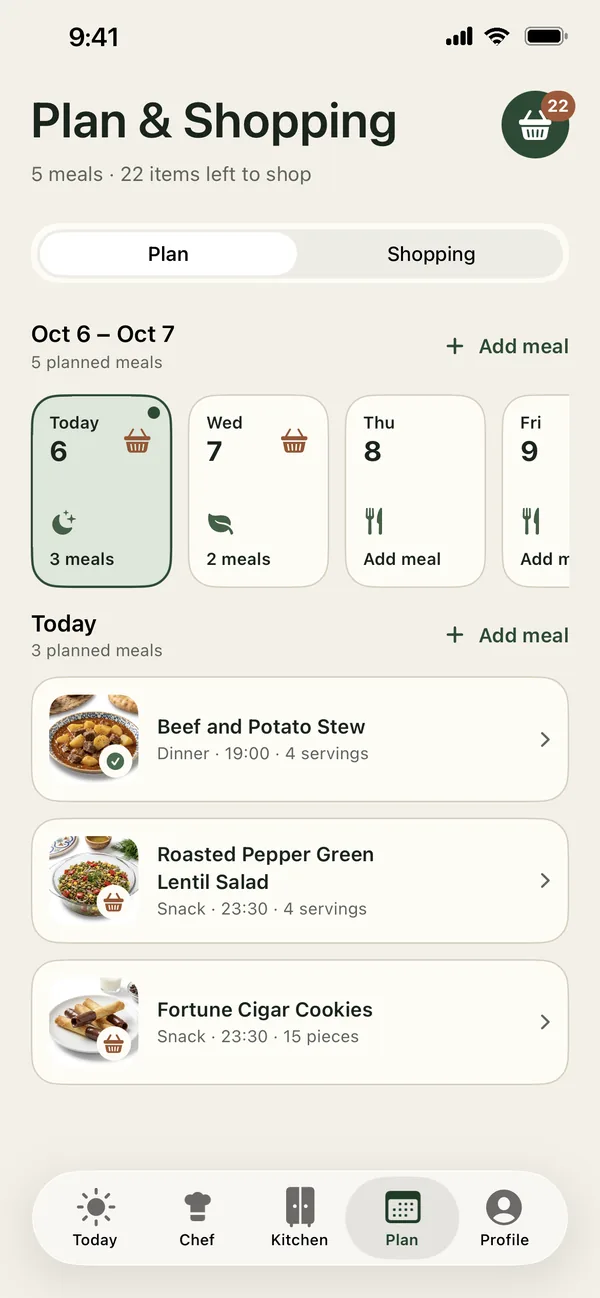
PantryWeave builds the week from what is already in your kitchen.
A week from what you have
You pick the recipes; PantryWeave places them across the week, checks what you already have and builds the grocery list.
Only what is missing
The shopping list adds up the amounts your recipes need and subtracts what is already in Kitchen, so it shows only what is missing. In the store, the list on your screen replaces a paper list. Afterwards you only adjust the amounts you actually bought and move them straight into your Kitchen.
Everything in its place
Kitchen shows where each item should be stored. When you finish your shopping list, or move items to Kitchen, each one goes into the right place: fridge, freezer or pantry. Move an item from the fridge to the freezer and Kitchen counts it as frozen.
What needs eating soon
Freshness checks with a Use first shelf show which ingredients need eating soon. When you mark a meal as cooked, PantryWeave asks you to confirm and updates Kitchen stock automatically.
What is the difference between use-by and best before?
In the UK, use-by dates go on food that goes off quickly, such as meat products and ready-to-eat salads. The Food Standards Agency says not to eat food after its use-by date, unless you cooked or froze it on or before that date. Best before dates are about quality: after them, food may not be at its best, and you can use sight, taste or smell to decide whether to eat it.
In the US, the USDA says a “Best if Used By/Before” date shows when a product will be of best flavor or quality, a “Use-By” date is the last date recommended for use at peak quality, and a “Freeze-By” date shows when to freeze a product to keep its peak quality. Spoiled food develops an off odor, flavor or texture and should not be eaten.
How long can food be left out of the fridge?
No more than 2 hours for perishable food in the US, or 1 hour when it is above 90 °F (32 °C) (FDA). In the UK, the Food Standards Agency says to cool cooked food and put it in the fridge within one to two hours.
What temperature should a fridge be?
Between 0 and 5 °C in the UK, where the Food Standards Agency recommends checking it with a fridge thermometer once a week, and 40 °F (4 °C) or below in the US, where the FDA also suggests a refrigerator thermometer.
Where the numbers come from
Read on October 30, 2026.
- EPA: preventing wasted food at home (planning, shopping, storage places, freezing, odds and ends)
- FDA: cutting food waste at home (impulse buys, fridge and freezer temperatures, the 2-hour rule)
- USDA: food product dating
- USDA: leftovers (3 to 4 days)
- GOV.UK: best before and use-by dates
- Food Standards Agency: chilling, freezing and defrosting (0 to 5 °C, −18 °C, 2 days for leftovers)
Frequently asked questions
How can I reduce food waste at home?
Check what you have before you shop, plan meals around what needs using up, buy only what is missing, store food where it keeps, freeze what you won’t eat in time, know what date labels mean, cook the right amount and use leftovers in time.
What does best before mean?
In the UK, best before dates are about quality: food may not be at its best after them, and you can use sight, taste or smell to decide. In the US, a “Best if Used By” date shows when a product will be of best flavor or quality.
How long can food be left out?
No more than 2 hours for perishable food, or 1 hour above 90 °F (32 °C), according to the FDA. In the UK, the Food Standards Agency says to cool cooked food and put it in the fridge within one to two hours.
What temperature should a fridge be?
Between 0 and 5 °C, according to the UK Food Standards Agency, and 40 °F (4 °C) or below, according to the FDA. A fridge thermometer is the way to check.
Is there an app that helps reduce food waste?
PantryWeave plans your week from what is already in your kitchen: you pick the recipes, it checks what you have and lists only what is missing, Kitchen shows where each item is stored, and a Use first shelf shows what needs eating soon.
Related guides

Waste less, starting this week
Download PantryWeave and plan your week from what you already have.

Free to start · iPhone