
Does honey go bad?
Honey, sugar, salt, vinegar, dry rice and dried pasta are the long-keepers of the pantry. Here is how long each staple lasts, opened and unopened, with the official source behind every number.

Short answer: Honey kept in a sealed container can stay stable for decades, says the National Honey Board, although over time it darkens, loses aroma and flavor, or crystallizes; the USDA’s FoodKeeper gives it 2 years in the pantry from the date of purchase. Sugar and table salt keep indefinitely. Dry white rice and dried pasta keep 2 years. Vinegar, peanut butter, spices and oils last months to years, and the best before date on these foods is about quality.
How PantryWeave keeps track of your pantry
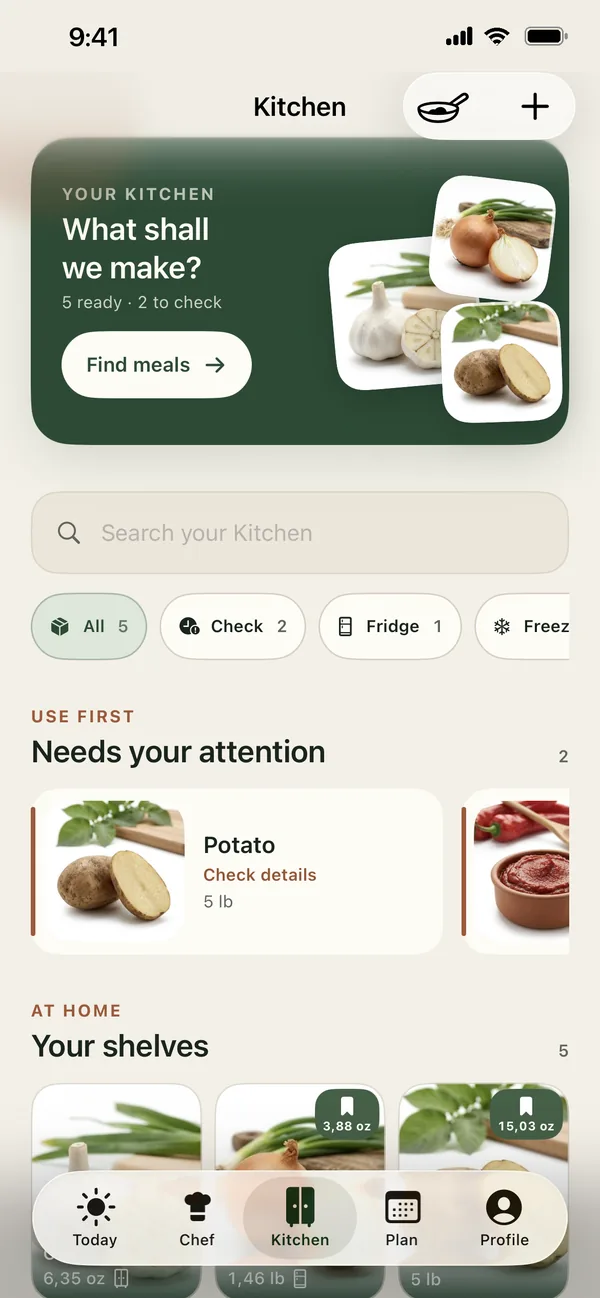
PantryWeave plans your meals from what is already in your Kitchen, and the stock stays current: when you mark a meal as cooked, the app asks and then updates Kitchen for you.
Every item in its place
Kitchen shows whether each item belongs in the pantry, the fridge or the freezer, so a new jar of honey or bag of rice is filed where it should live.
Put the shopping away in one step
After the store you only correct the quantities you bought and send them straight to Kitchen, where each one lands in its pantry, fridge or freezer spot.
Tracked by where it is kept
Kitchen follows each item’s freshness, or a suggested day to use it by, according to where you keep it, and the Use first shelf brings forward what needs eating soon.
A reminder, not a label date
Freshness in the app is an estimate meant as a reminder. The shelf lives on this page come from official sources, and checking the food itself still matters.
How long pantry staples last
Times from the USDA’s FoodKeeper; most unopened times count from the date of purchase. The rice and pasta rows match the USDA’s shelf-stable food chart. Store these foods in a cool, dry place; the USDA says below 85 °F (29 °C) is best for shelf-stable food.
| Food | In the pantry | Once opened |
|---|---|---|
| Honey | 2 years | — |
| Sugar: granulated, brown or confectioners | Indefinitely | 18 to 24 months for best quality |
| Salt: table, plain or iodized | Indefinitely | — |
| White or wild rice, dry | 2 years | 1 year, or 6 months in the fridge |
| Brown rice, dry | 1 year | 1 year, or 6 months in the fridge |
| Dried pasta without eggs | 2 years | 1 year |
| Vinegar | 2 years | — |
| Apple cider vinegar | Indefinitely | — |
| Balsamic vinegar | 3 to 5 years | 18 months in the fridge |
| Peanut butter, commercial with stabilizers | 6 to 9 months | 2 to 3 months, or 3 to 4 months in the fridge |
| Peanut butter, natural | Fridge: 12 months | 3 to 4 months in the fridge |
| Whole spices | 3 to 4 years | 3 to 4 years |
| Ground spices | 2 to 3 years | 2 to 3 years |
| Dried herbs | 1 to 2 years | 1 to 2 years |
| Olive or vegetable oil | 6 to 12 months | 3 to 5 months, or 4 months in the fridge |
| Coconut oil | 3 years | — |
| Pure maple syrup, unopened | 4 years in glass, 2 years in plastic | — |
| Soy sauce | 3 years | 1 month in the fridge |
| Baking soda | 2 to 3 years | 6 months |
| White flour | 6 to 12 months | 6 to 8 months, or 1 year in the fridge |
| Pickles | 1 year | 1 to 3 months in the fridge |
Does honey go bad or expire?
Honey changes very slowly. The National Honey Board says sealed honey can stay stable for decades, even centuries, but that it still changes in the jar: it darkens, loses aroma and flavor, or crystallizes. Those changes depend on temperature, which is why the Board calls honey’s shelf life difficult to define and notes that 2 years is often given for practical purposes. FoodKeeper lists the same 2 years, and only for the pantry.
Crystallized honey is still honey. The Board describes crystallizing as a natural process and says you can eat the honey as it is. To make it runny again, stand the jar in warm water and stir until the crystals dissolve, or warm it in a microwavable container with the lid off, stirring every 30 seconds. Do not let it boil or scorch.
Does vinegar go bad?
Vinegar keeps for years rather than months. FoodKeeper gives plain vinegar 2 years in the pantry and lists apple cider vinegar as keeping indefinitely. Balsamic vinegar gets 3 to 5 years unopened and 18 months in the fridge once the bottle is open.
Does peanut butter go bad, and does it need the fridge?
Peanut butter does change, and the type matters. A commercial jar made with hydrogenated fat or other stabilizers keeps 6 to 9 months unopened in the pantry, then 2 to 3 months there after opening; in the fridge, an opened jar lasts 3 to 4 months. FoodKeeper lists natural peanut butter only for the fridge: 12 months unopened, or the date on the jar if that comes first, and 3 to 4 months once opened.
Do sugar and salt expire?
Neither has a shelf-life limit in FoodKeeper: granulated, brown and confectioners sugar are listed as indefinite, and so is table salt. For sugar, FoodKeeper adds a quality note: “Sugar never spoils, but for best quality use within 2 years of opening.”
Does rice or dried pasta go bad?
Dry rice and dried pasta keep 2 years on the shelf in the USDA’s shelf-stable food chart; FoodKeeper gives brown rice a shorter 1 year. Once the bag is open, FoodKeeper gives white rice, brown rice and dried pasta 1 year. The NHS says dried pasta can be stored in a cupboard and typically has a long shelf life, while fresh pasta needs the fridge. Cooked, both become leftovers with much shorter times; see how long cooked rice and other leftovers last. For ideas, browse recipes with rice and recipes with pasta.
Do spices and cooking oils go bad?
FoodKeeper gives whole spices 3 to 4 years, ground spices 2 to 3 years and dried herbs 1 to 2 years, opened or not. Olive or vegetable oil keeps 6 to 12 months unopened and 3 to 5 months after opening, or 4 months in the fridge; sesame oil keeps 2 years unopened and 6 months once opened, and coconut oil 3 years.
Maple syrup, soy sauce and baking staples
Unopened pure maple syrup keeps 4 years in glass and 2 years in plastic. Soy sauce keeps 3 years unopened; FoodKeeper says shelf-stable commercial soy sauce can stay at room temperature after opening, and that labels suggest the fridge for quality, which keeps it fresh longer. Baking soda keeps 2 to 3 years unopened but only 6 months once opened, and white flour 6 to 12 months unopened. Whether butter belongs in the fridge is covered in our guide to what goes in the fridge and what stays in the pantry.
What the date on the pack means
US: the USDA says a “Best if Used By” or “Best if Used Before” date shows when a product will be at its best flavor or quality, and that, apart from infant formula, federal law does not require dates at all. Spoiled food develops an off odor, flavor or texture; if it has, do not eat it.
UK: government guidance says best before dates relate to quality and appear on dried foods such as pasta and rice and on tinned foods. After the date the food may not be at its best, and you can use sight, taste or smell to decide whether to eat it, for example by checking biscuits or crisps for staleness.
Where the numbers come from
Read on October 30, 2026.
- USDA FoodKeeper app (the chart rows: honey, sugar, salt, rice, pasta, vinegar, peanut butter, spices, oils, maple syrup, soy sauce, baking soda, flour and pickles)
- USDA FSIS: shelf-stable food (rice and dried pasta, storage temperature)
- USDA FSIS: food product dating
- National Honey Board: honey FAQ (shelf life and crystallizing)
- UK government: best before and use-by dates
- NHS: starchy foods (dried pasta)
Frequently asked questions
Does honey go bad?
Not in the way most foods do. The National Honey Board says honey in a sealed container can stay stable for decades, even centuries, but over time it darkens, loses aroma and flavor, or crystallizes. If in doubt, the Board’s advice is to throw it out.
Does honey expire?
There is no fixed point, because the changes depend on temperature. The National Honey Board says a shelf life of 2 years is often given for practical purposes, and the USDA’s FoodKeeper lists honey at 2 years in the pantry from the date of purchase.
Does peanut butter go bad?
Yes, slowly. FoodKeeper gives commercial peanut butter made with hydrogenated fat or other stabilizers 6 to 9 months unopened in the pantry, then 2 to 3 months once opened, or 3 to 4 months opened in the fridge. Natural peanut butter is a fridge item: 3 to 4 months once opened.
Does vinegar go bad?
It keeps for years. FoodKeeper lists vinegar at 2 years in the pantry from purchase, apple cider vinegar as indefinite, and balsamic vinegar at 3 to 5 years unopened, or 18 months in the fridge once opened.
Does rice go bad?
Dry white rice keeps 2 years on the shelf, according to the USDA, and brown rice 1 year, according to FoodKeeper. Cooked rice is a different matter: the NHS says to eat it within 24 hours, and the USDA gives 3 to 4 days in the fridge.
Does sugar expire?
No. FoodKeeper lists granulated, brown and confectioners sugar as keeping indefinitely in the pantry and says sugar never spoils, but that it is best used within 2 years of opening. Table salt keeps indefinitely too.
Related guides

Know what is on your shelves
Download PantryWeave and see what you have in the pantry, fridge and freezer, and what needs using first.

Free to start · iPhone