
How long will food keep in the fridge?
How long will food keep in the fridge? Health Canada’s chart gives fresh beef and lamb 2 to 4 days and ground meat 1 to 2 days in a refrigerator at 4 °C (40 °F) or lower, and the USDA’s FoodKeeper gives beef steaks 3 to 5 days and ground beef 1 to 2 days from the date of purchase. Below: raw meat, poultry, fish, eggs, dairy and vegetables, both sources side by side, and how Health Canada says to store raw food.

Short answer: Health Canada’s chart gives fresh beef and lamb 2 to 4 days, ground meat 1 to 2 days, whole chicken or turkey 2 to 3 days, lean and fatty fish 3 to 4 days and eggs in the shell 3 to 4 weeks, in a refrigerator at 4 °C (40 °F) or lower. The USDA’s FoodKeeper, counting from the date of purchase, gives beef steaks 3 to 5 days, ground beef 1 to 2 days, whole chicken 1 to 2 days, lean and fatty fish 1 to 2 days and eggs in the shell 3 to 5 weeks. Cooked leftovers have their own chart, in our guide how long are leftovers good for?
How long fresh food keeps in the fridge, by source
Each row is a food in Health Canada’s fridge and freezer storage chart, with its refrigerator time at 4 °C (40 °F) or lower, next to the row of the USDA’s FoodKeeper for the same food, named as FoodKeeper names it. In this table, FoodKeeper counts its times from the date of purchase, except for raw egg whites and yolks, cooked shellfish and milk, and gives some foods a separate time after opening. Health Canada’s chart also lists ham, pre-cooked sausages, deli or homemade salads, egg substitutes, more cheeses, tomatoes, leftovers and frozen dinners; leftovers are in our guide how long are leftovers good for?
| Food (Health Canada’s row) | Health Canada, refrigerator at 4 °C (40 °F) or lower | USDA FoodKeeper (its row and time) |
|---|---|---|
| Fresh meat | ||
| Beef | 2 to 4 days | Beef, steaks: 3 to 5 days from the date of purchase |
| Lamb | 2 to 4 days | Lamb, chops, ribs, or loin: 3 to 5 days from the date of purchase |
| Veal | 3 to 4 days | Veal, shoulder roast, boneless: 3 to 5 days from the date of purchase |
| Ground meat | 1 to 2 days | Beef, ground; lamb, ground; veal, ground: 1 to 2 days from the date of purchase |
| Fresh poultry | ||
| Chicken/Turkey, whole | 2 to 3 days | Chicken, whole; turkey, whole: 1 to 2 days from the date of purchase |
| Chicken/Turkey, pieces | 2 to 3 days | Chicken parts, breast halves, bone-in; chicken parts, breast halves, boneless; chicken parts, legs or thighs: 1 to 2 days from the date of purchase |
| Fresh fish | ||
| Lean fish (cod, flounder etc.) | 3 to 4 days | Lean fish (cod, flounder, haddock, halibut, sole, etc.): 1 to 2 days from the date of purchase |
| Fatty fish (salmon etc.) | 3 to 4 days | Fatty fish (bluefish, catfish, mackerel, mullet, salmon, tuna, etc.): 1 to 2 days from the date of purchase |
| Shellfish (clams, crab, lobster etc.) | 12 to 24 hours | Live clams, mussels, crab, and oysters: 1 to 2 days from the date of purchase |
| Scallops, shrimp, cooked shellfish | 1 to 2 days | Scallops; shrimp, crayfish: 1 to 3 days from the date of purchase; cooked shellfish, all: 3 to 4 days |
| Bacon, sausages and hot dogs | ||
| Bacon | 1 week | Bacon: 1 week from the date of purchase; 1 week after opening |
| Raw sausage | 1 to 2 days | Sausage, raw bulk type or patties: 1 to 2 days from the date of purchase |
| Hot dogs | Un-opened: 2 weeks; opened: 1 week | Hot dogs: 2 weeks from the date of purchase; 1 week after opening |
| Lunch meat and deli food | ||
| Lunch meat | Un-opened: 2 weeks; opened: 3 to 5 days | Luncheon meat or poultry, pre-packaged: 2 weeks from the date of purchase; 3 to 5 days after opening |
| Deli packaged lunch meat | 3 to 4 days | Luncheon meat or poultry, store-sliced: 3 to 5 days from the date of purchase |
| Eggs | ||
| Fresh in shell | 3 to 4 weeks | Eggs, in shell: 3 to 5 weeks from the date of purchase |
| Fresh out of shell | 2 to 4 days | Eggs, raw whites, yolks: 2 to 4 days |
| Dairy products | ||
| Milk | Un-opened: best before date; opened: 3 days | Milk, plain or flavored: package use-by date |
| Cottage cheese | Un-opened: best before date; opened: 3 days | Cottage cheese: 2 weeks from the date of purchase; 1 week after opening |
| Yogurt | Un-opened: best before date; opened: 3 days | Yogurt: 1 to 2 weeks from the date of purchase |
| Soft cheese | 1 week | Cheese, soft such as brie, bel paese, goat: 1 to 2 weeks from the date of purchase |
| Hard cheese | 10 months | Cheese, hard such as cheddar, swiss, block parmesan: 6 months from the date of purchase; 3 to 4 weeks after opening |
| Butter | Un-opened salted butter: 8 weeks; un-opened unsalted butter: 8 weeks; opened butter: 3 weeks | Butter: 1 to 2 months from the date of purchase |
| Vegetables | ||
| Beans, green or waxed | 5 days | Beans and peas (green, fava, lima, soybean, wax, snow, sugar snap): 3 to 5 days from the date of purchase |
| Carrots | 2 weeks | Carrots, parsnips: 2 to 3 weeks from the date of purchase |
| Celery | 2 weeks | Celery: 1 to 2 weeks from the date of purchase |
| Leaf lettuce | 3 to 7 days | Lettuce, leaf, spinach: 3 to 7 days from the date of purchase |
| Iceberg lettuce | 1 to 2 weeks | Lettuce, iceberg, romaine: 1 to 2 weeks from the date of purchase |
| Spinach | 2 to 4 weeks | Lettuce, leaf, spinach: 3 to 7 days from the date of purchase |
| Summer squash | 1 week | Squash, summer and zucchini: 4 to 5 days from the date of purchase |
| Winter squash | 2 weeks | Squash, winter: 1 to 3 months from the date of purchase |
How long do raw meat, poultry and fish last in the fridge?
Health Canada’s chart gives fresh beef and lamb 2 to 4 days, veal 3 to 4 days and ground meat 1 to 2 days. It gives whole chicken or turkey and chicken or turkey pieces 2 to 3 days, lean fish such as cod and flounder and fatty fish such as salmon 3 to 4 days, shellfish such as clams, crab and lobster 12 to 24 hours, and scallops, shrimp and cooked shellfish 1 to 2 days.
The USDA’s FoodKeeper, counting from the date of purchase, gives beef steaks and lamb chops 3 to 5 days, and ground beef, lamb and veal 1 to 2 days. It gives whole chicken, whole turkey and chicken parts 1 to 2 days, lean fish and fatty fish 1 to 2 days, live clams, mussels, crab and oysters 1 to 2 days, and scallops and shrimp 1 to 3 days. FoodKeeper gives cooked shellfish 3 to 4 days.
Ground beef and chicken have their own guides: how long does ground beef last in the fridge? and how long does cooked chicken last in the fridge?
How long do eggs, milk and cheese keep in the fridge?
Health Canada’s chart gives eggs in the shell 3 to 4 weeks and eggs out of the shell 2 to 4 days. The USDA’s FoodKeeper gives eggs in the shell 3 to 5 weeks from the date of purchase and raw egg whites and yolks 2 to 4 days.
For milk, cottage cheese and yogurt, Health Canada’s chart gives the un-opened product its best before date and the opened product 3 days. FoodKeeper gives milk the package use-by date, cottage cheese 2 weeks from the date of purchase and 1 week after opening, and yogurt 1 to 2 weeks from the date of purchase. For hard cheese, Health Canada gives 10 months, and FoodKeeper gives hard cheese such as cheddar 6 months from the date of purchase and 3 to 4 weeks after opening. For butter, Health Canada gives un-opened butter 8 weeks and opened butter 3 weeks, and FoodKeeper gives butter 1 to 2 months from the date of purchase. Eggs have their own guide: how to tell if eggs are bad, and how long eggs last.
How long do vegetables last in the fridge?
Health Canada’s chart gives green or waxed beans 5 days, carrots and celery 2 weeks each, leaf lettuce 3 to 7 days, iceberg lettuce 1 to 2 weeks, spinach 2 to 4 weeks, summer squash 1 week and winter squash 2 weeks. Of tomatoes, it says: “Don’t refrigerate.”
The USDA’s FoodKeeper, counting from the date of purchase, gives green beans and other beans and peas 3 to 5 days, carrots and parsnips 2 to 3 weeks, celery 1 to 2 weeks, leaf lettuce and spinach 3 to 7 days, iceberg and romaine lettuce 1 to 2 weeks, summer squash and zucchini 4 to 5 days and winter squash 1 to 3 months. Which foods belong in the fridge and which in the pantry is in our guide fridge or pantry? Does butter need to be refrigerated?
How does Health Canada say to store raw food in the fridge?
Health Canada says: “Make sure your refrigerator is set at 4 °C (40 °F) or lower and your freezer at -18 °C (0 °F) or lower.” It says: “Keep your raw meat, poultry, fish and seafood cold. Refrigerate or freeze them as soon as you get home from the grocery store.” It also says: “Place raw meat, poultry, fish and seafood in sealed containers or plastic bags on the bottom shelf of your refrigerator so raw juices won’t drip onto other food.” It also says: “Refrigerate fresh fruits and vegetables that need refrigeration when you get home. This includes all pre-cut and ready-to-eat produce.”
Health Canada calls the refrigerator times in its chart “recommended refrigeration times”. It also says: “When in doubt, throw it out!” Freezer times, freezer burn and thawing are in our guide how to freeze food and prevent freezer burn.
What about leftovers?
Health Canada’s chart has a Leftovers section: cooked meat, stews, egg or vegetable dishes; cooked poultry and fish; meat broth and gravy; and soups. How long cooked leftovers keep, with US and UK guidance side by side, is in our guide how long are leftovers good for?
How PantryWeave keeps track of your kitchen
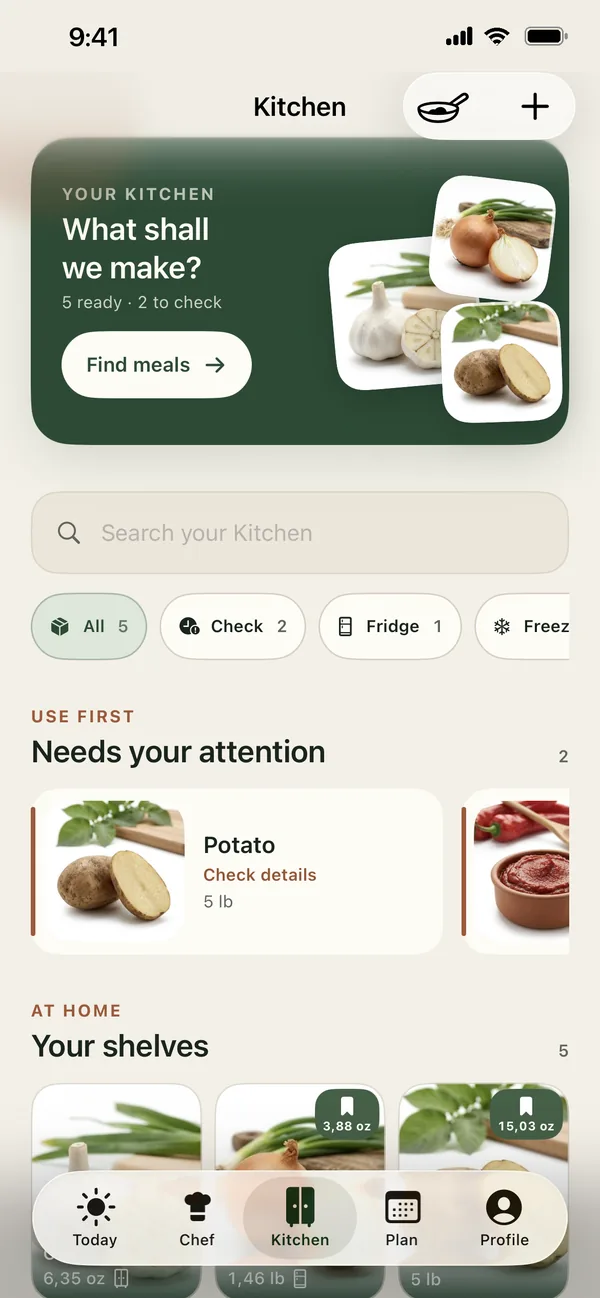
PantryWeave keeps track of your kitchen: it plans your meals from what is already in your Kitchen, and the stock stays current: when you mark a meal as cooked, you choose whether the app deducts its ingredients from Kitchen or keeps Kitchen unchanged.
Every item in its place
Kitchen shows whether each item belongs in the pantry, the fridge or the freezer.
Put the shopping away in one step
Put the shopping away in one step: tick what you buy in the store and send it straight to Kitchen, where each item lands in its pantry, fridge or freezer spot. You correct a quantity only if it differs from the list.
Tracked by where it is kept
Kitchen tracks each item’s freshness, or a suggested day to use it by, according to where you keep it, and the Use first shelf brings forward what needs eating soon.
A reminder, not a label date
Freshness in the app is an estimate meant as a reminder, not a label date.
Where the times come from
- Health Canada: fridge and freezer storage (page dated April 11, 2024; read on November 19, 2026)
- USDA FoodKeeper (fresh meat, poultry and seafood; bacon, sausage and hot dogs; luncheon meat; eggs; dairy; fresh vegetables; FoodKeeper data file, version 128, as archived on July 2, 2025; read on November 19, 2026)
Frequently asked questions
How long does raw meat last in the fridge?
Health Canada’s chart gives fresh beef and lamb 2 to 4 days, veal 3 to 4 days and ground meat 1 to 2 days in a refrigerator at 4 °C (40 °F) or lower. The USDA’s FoodKeeper gives beef steaks and lamb chops 3 to 5 days, and ground beef, lamb and veal 1 to 2 days, from the date of purchase.
How long does raw chicken or fish last in the fridge?
Health Canada’s chart gives whole chicken or turkey and chicken or turkey pieces 2 to 3 days, and lean fish such as cod and fatty fish such as salmon 3 to 4 days. The USDA’s FoodKeeper gives whole chicken, chicken parts, lean fish and fatty fish 1 to 2 days from the date of purchase.
How long do eggs, milk and cheese keep in the fridge?
Health Canada’s chart gives eggs in the shell 3 to 4 weeks; the USDA’s FoodKeeper gives them 3 to 5 weeks from the date of purchase. For milk, Health Canada gives un-opened milk its best before date and opened milk 3 days, and FoodKeeper gives the package use-by date. For hard cheese, Health Canada gives 10 months, and FoodKeeper gives 6 months from the date of purchase and 3 to 4 weeks after opening.
How long do vegetables last in the fridge?
Health Canada’s chart gives carrots and celery 2 weeks each and leaf lettuce 3 to 7 days. The USDA’s FoodKeeper gives carrots 2 to 3 weeks, celery 1 to 2 weeks and leaf lettuce 3 to 7 days from the date of purchase. Of tomatoes, Health Canada’s chart says: “Don’t refrigerate.”
Related guides

Know what is in your fridge
Download PantryWeave and see what is in your fridge, freezer and pantry, and what needs using first.

Free to start · iPhone