
How long do potatoes last?
In five university extension guides, whole potatoes last 1 to 4 weeks at room temperature or in the pantry, and up to 3 months at 45 to 50 °F (7 to 10 °C) in Clemson’s. Here is what six university extension guides and the UK Food Standards Agency say about storing potatoes, keeping them in the fridge and freezing them.

Short answer: At room temperature or in the pantry, whole white potatoes last 1 to 4 weeks, depending on the guide: 1 week in the guides from Clemson’s Home & Garden Information Center and New Mexico State University, and 2 to 4 weeks at 70 °F (21 °C) in Ohio State University Extension’s guide. Somewhere cooler they last much longer: Clemson gives 1 to 3 months at 45 to 50 °F (7 to 10 °C). The USDA FoodKeeper times are in our guide to what goes in the fridge and what stays in the pantry.
Potato storage times by guide and temperature
Times for whole fresh white potatoes, with the temperature each guide gives. For the fridge, see below.
| Guide | Room temperature or pantry | Cooler storage |
|---|---|---|
| NDSU Extension (2023) | Pantry: 1 to 2 weeks | Below 50 °F (10 °C) for longer storage |
| Clemson Home & Garden Information Center (2020) | 1 week | 1 to 3 months at 45 to 50 °F (7 to 10 °C) |
| New Mexico State University (2025) | Pantry: 1 week | 50 to 60 °F (10 to 16 °C) for longer storage |
| Purdue Extension (2001) | 2 weeks at 70 °F (21 °C) | Usually keep best in cool, dark places, preferably around 50 to 60 °F (10 to 16 °C) |
| Ohio State University Extension (2010) | 2 to 4 weeks at 70 °F (21 °C) | About 50 °F (10 °C) for longer storage |
| Iowa State University (2024) | — | 40 °F (4 °C) and 90 to 95 percent relative humidity, dark (home-grown potatoes after curing) |
How to store potatoes
- Cool: Purdue Extension says to store potatoes in the coolest parts of the cupboard, and that cabinets over the range, near the dishwasher or by the refrigerator exhaust are too warm for food.
- Dark and dry: potatoes turn green when exposed to light, Iowa State University says; New Mexico State University says to keep fresh potatoes dry and away from the sun.
- Away from fruit: do not store potatoes with apples or other fruit, Iowa State University says; the reason is under “Why potatoes sprout”.
- In spring: Purdue Extension says white potatoes sprout in the spring, so at that time of year buy only what you can use in a week.
Why potatoes sprout
Warmth is one reason. New Mexico State University says warmer temperatures encourage sprouting, and Iowa State University says cured home-grown potatoes stored above 50 °F (10 °C) may begin to sprout in 2 or 3 months. Fruit is another: Iowa State says ripening fruit gives off ethylene gas, which promotes sprouting.
The UK Food Standards Agency says: “If potatoes have sprouted, simply remove the sprouts before use. Remember to cut off any green or rotten bits before using.”
Can you store potatoes in the fridge?
The guides differ. The UK Food Standards Agency says that, to help avoid food waste, you can choose to store potatoes either in the fridge or in a cool, dark, dry place. New Mexico State University’s guide says not to refrigerate fresh potatoes, although the same row of its timetable lists 1 to 2 weeks under Refrigerator.
Can you freeze potatoes?
The UK Food Standards Agency says you can freeze cooked potatoes, or parboiled potatoes that have been boiled for 5 minutes, and leftover cooked potatoes too. It says you can roast boiled potatoes straight from the freezer, in the oven with a little oil to crisp them up, and to make sure they are steaming hot all the way through. How long cooked potatoes last in the fridge and freezer is in our leftover storage chart.
Sweet potatoes and the fridge
NDSU Extension, Purdue Extension and Ohio State University Extension all say not to refrigerate sweet potatoes. Why they don’t belong in the fridge, and how to freeze them, is in our guide to how long sweet potatoes last.
How PantryWeave keeps track of your potatoes
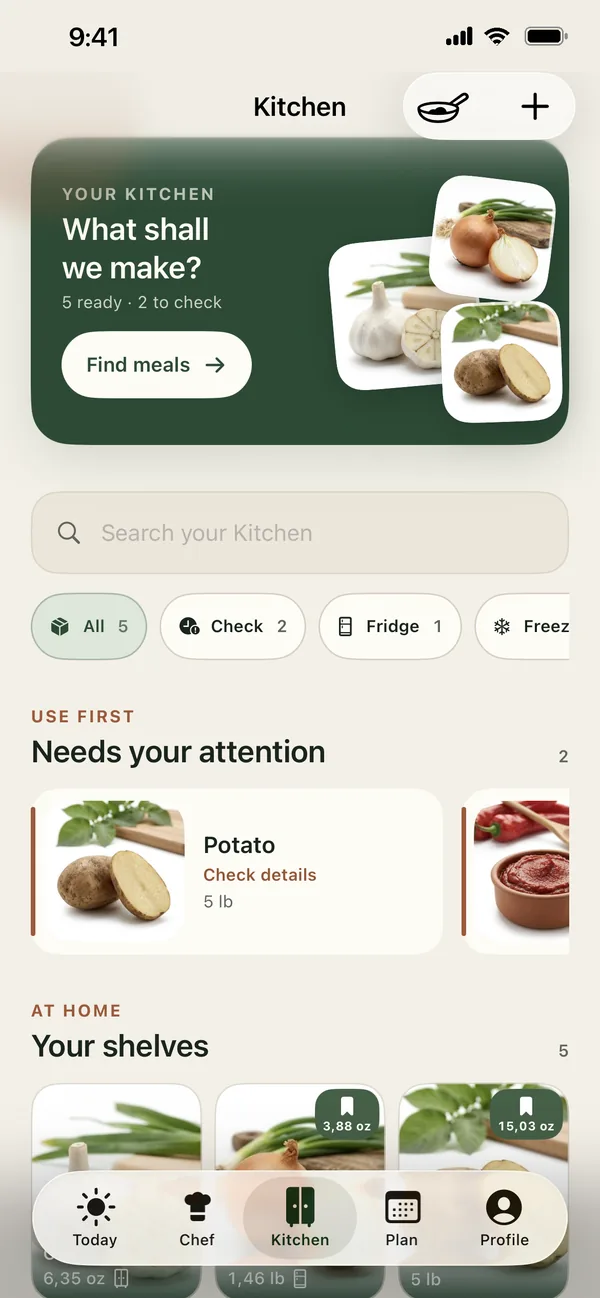
Kitchen in PantryWeave keeps the fridge, the freezer and the pantry apart, and it stays current: mark a meal as cooked and choose whether the app deducts its ingredients from your stock or keeps Kitchen unchanged.
Fridge or freezer, set for you
Kitchen shows where each item should be stored. When you finish your shopping list, or move items to Kitchen, each one goes into the right place: fridge, freezer or pantry.
Counted as frozen
Move an item from the fridge to the freezer and Kitchen counts it as frozen.
Tracked by where it is kept
Kitchen follows each item’s freshness, or a suggested day to use it by, according to where you keep it, and the Use first shelf brings forward what needs eating soon.
A guide, with the food itself as the check
For items with freshness tracking, the app’s freshness dates follow where an item is stored and are a guide. Check the food itself before you eat it.
Where the times come from
Read on November 16, 2026.
- NDSU Extension: Food Storage Guide (FN579) (reviewed January 2023: potatoes in the pantry, below 50 °F for longer storage, sweet potatoes)
- Clemson Home & Garden Information Center: Food Storage: Pantry (HGIC 3525) (revised March 27, 2020: 1 to 3 months at 45 to 50 °F, 1 week at room temperature)
- New Mexico State University: Guide E-118, Table 1 (Food Storage Timetable) (revised April 2025: fridge and pantry times, 50 to 60 °F, sprouting, not refrigerating fresh potatoes)
- Purdue Extension: Spotlight on Cupboard Storage (CFS-423) (reviewed December 2001: times at 70 °F, the coolest parts of the cupboard, 50 to 60 °F, sprouting in spring, sweet potatoes)
- Ohio State University Extension: Pantry Food Storage (HYG-5401) (originally posted December 9, 2010: times at 70 °F, about 50 °F for longer storage, sweet potatoes)
- Iowa State University Extension: How should I store potatoes? (last updated July 30, 2024: 40 °F and humidity for home-grown potatoes, light, sprouting, fruit)
- Food Standards Agency: home food fact checker (updated August 21, 2026; guidance for England, Wales and Northern Ireland: the fridge or a cool, dark, dry place, sprouted and green potatoes, freezing cooked and parboiled potatoes)
Frequently asked questions
How long do potatoes last at room temperature?
1 to 4 weeks, depending on the guide. Clemson’s Home & Garden Information Center gives 1 week at room temperature and New Mexico State University 1 week in the pantry; NDSU Extension gives 1 to 2 weeks in the pantry, Purdue Extension 2 weeks at 70 °F (21 °C) and Ohio State University Extension 2 to 4 weeks at 70 °F. Somewhere cooler they last much longer: Clemson gives 1 to 3 months at 45 to 50 °F (7 to 10 °C).
How should you store potatoes?
Somewhere cool and dark. The UK Food Standards Agency says a cool, dark, dry place; Purdue Extension says to store them in the coolest parts of the cupboard, away from the range, the dishwasher and the refrigerator exhaust; and Iowa State University says potatoes turn green when exposed to light and should not be stored with apples or other fruit.
Can you store potatoes in the fridge?
The UK Food Standards Agency says that, to help avoid food waste, you can choose to store potatoes either in the fridge or in a cool, dark, dry place. New Mexico State University’s guide says not to refrigerate fresh potatoes.
Can you freeze potatoes?
The UK Food Standards Agency says you can freeze cooked potatoes, or parboiled potatoes that have been boiled for 5 minutes, and leftover cooked potatoes too. It says you can roast boiled potatoes straight from the freezer, and to make sure they are steaming hot all the way through.
Why do potatoes sprout?
Warmth is one reason. New Mexico State University says warmer temperatures encourage sprouting, and Iowa State University says cured home-grown potatoes stored above 50 °F (10 °C) may begin to sprout in 2 or 3 months. It adds that ripening fruit gives off ethylene gas, which promotes sprouting.
Related guides

Use up the potatoes in your cupboard
Download PantryWeave and see what to use first in your kitchen.

Free to start · iPhone