


How to store homemade bread
What five extension services say about keeping homemade bread: room-temperature and freezer times side by side, a sourdough loaf at room temperature, bread in the fridge, and how to freeze and thaw it.

Short answer: Nebraska Extension’s home food storage chart gives homemade bread 3 to 5 days at room temperature and 3 months in the freezer. Clemson University’s Home & Garden Information Center says to store breads at room temperature and use them within 3 to 7 days or freeze them. Cornell Cooperative Extension, passing on tips from Iowa State University’s AnswerLine, says that if you want to keep your bread for more than a day or two, the freezer is your best option, and that storing bread in the refrigerator is not a good idea. Times for other foods are in our chart of how long leftovers last.
Homemade bread at room temperature and in the freezer, by source
Each row is one source, in its own words. Freezer times are for quality. What each source says about the fridge is below.
| Source | Room temperature | Freezer |
|---|---|---|
| Nebraska Extension | 3 to 5 days | 3 months |
| University of Illinois Extension | 3 to 5 days for sourdough | Up to 2 months for sourdough; 2 to 3 months for baked yeast bread; 3 months for bread |
| Pacific Northwest Extension | 2 to 4 days | 2 to 3 months |
| Clemson University | Use within 3 to 7 days | Or freeze; no time given |
| Cornell Cooperative Extension | Not given; the freezer for more than a day or two | Best within 6 months |
University of Illinois Extension gives three freezer times: up to two months for best quality in its sourdough guide, and, in its freezer storage chart, 2 to 3 months for baked yeast bread and rolls and 3 months for bread in a heavy-duty freezer bag.
A sourdough loaf at room temperature
- Before slicing: University of Illinois Extension says to let a sourdough loaf cool for at least an hour before slicing.
- Somewhere it can breathe: for sourdough bread, Illinois suggests a linen bread bag to allow it to breathe, or a bread bin, paper bag, cooled Dutch oven or cake carrier.
- The crust softens: Illinois says sourdough bread will start to lose its crispy crust, and suggests refreshing it in the toaster, or spritzing it with water and warming it in the oven.
Bread in the fridge
Cornell Cooperative Extension says the refrigerator draws moisture out of the bread, causing it to go stale faster. University of Illinois Extension says refrigeration temperatures will dry the bread.
The Pacific Northwest Extension guide says storing bread in a refrigerator extends the time before mold grows but causes bread to go stale more quickly. For baked bread without preservatives, it says to store it in the refrigerator to inhibit mold growth, but that it will stale more rapidly, and gives it 1 to 2 weeks there. Clemson University’s Home & Garden Information Center says storing breads in the refrigerator promotes spoilage, but that in humid weather it may be necessary to store them in the refrigerator or freezer, in air- and moisture-proof wrapping, to prevent molding if the loaf will not be eaten within a week.
How to freeze homemade bread
- Cool it completely. Cornell Cooperative Extension says to make sure your bread is completely cool before packaging it, so moisture is not trapped; University of Illinois Extension says this usually takes at least one hour for sourdough.
- Wrap it twice. Cornell says to wrap the bread in plastic, then again in foil, and to place it in a freezer bag or other airtight packaging, using a straw to suck the extra air out of the bag before sealing it. Illinois says to freeze a whole sourdough loaf wrapped in aluminum foil and placed in a plastic bag.
- Slice it if you will use it bit by bit. Cornell says slicing before freezing lets you pull out smaller amounts. Illinois says to freeze slices on a baking sheet so they don’t stick together, then stack them back into a loaf in a plastic bag or freezer container.
- How long: Cornell says to use frozen bread within 6 months for best quality; Illinois gives up to two months for sourdough and 3 months for bread in a heavy-duty freezer bag; Nebraska Extension gives homemade bread 3 months.
University of Illinois Extension notes that freezing does not refresh baked goods; it can only keep the quality they had before freezing. More on wrapping and freezer burn is in our guide to how to freeze food.
Thawing and refreshing bread
- Thaw it wrapped. Cornell Cooperative Extension says to defrost bread at room temperature in its wrapping; if you unwrap it while it is still cold, condensation forms on the outside and affects the texture. It thaws in about 3 hours.
- Crisp the crust. Once it is fully defrosted, Cornell says to unwrap it and reheat it at 300 to 350 °F for 10 minutes. Single slices can be defrosted in the toaster.
- Stale bread: to revive it, Cornell suggests flicking a little water on the crust, wrapping it in foil and heating it in a 300 °F oven for 5 to 10 minutes, or using it for bread pudding, French toast or croutons.
How PantryWeave helps
PantryWeave starts every plan from what is already in your kitchen.
Tracked by freshness
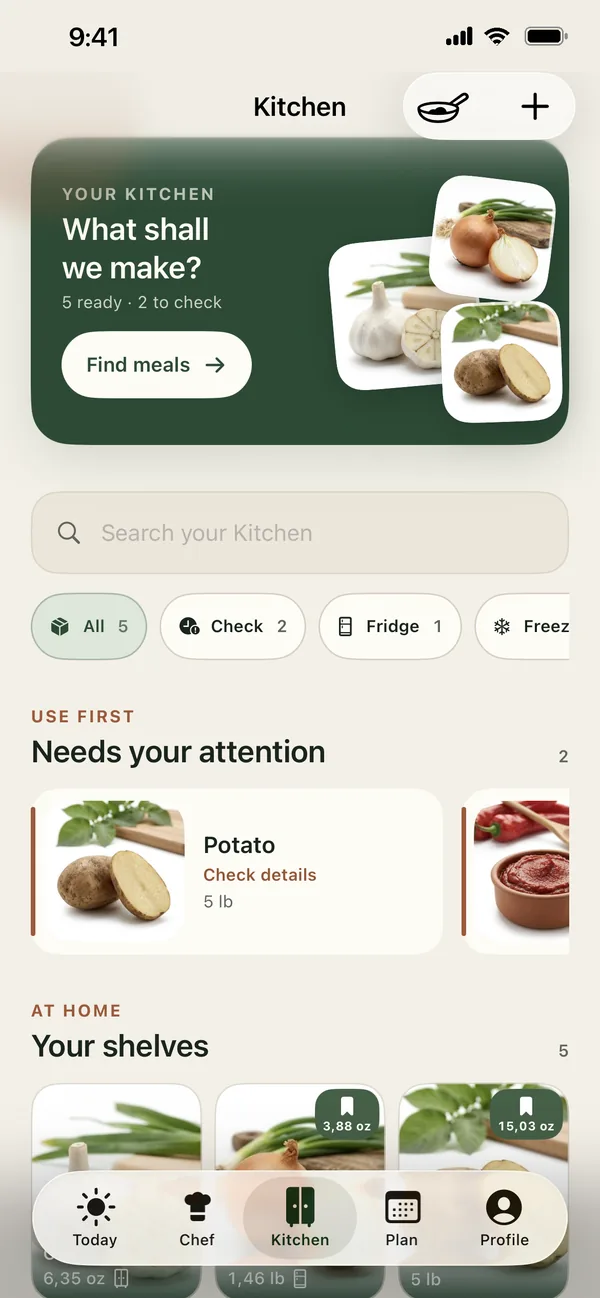
PantryWeave keeps track of what is in your fridge, freezer and pantry: for items with freshness tracking, freshness follows where they are stored, and the Use first shelf shows what to eat before it goes off.
What needs eating soon
Freshness checks with a Use first shelf show which ingredients need eating soon.
A week from what you have
You pick the recipes and plan your week; PantryWeave checks what you already have and builds the grocery list.
An estimate, not an official date
The app’s freshness check is an estimate, not a guarantee. The official storage times are the ones on this page. Always check the food itself too.
Where the times come from
Extension guides read on November 17, 2026.
- Clemson University Home & Garden Information Center: food safety answers for college students (breads at room temperature, in the fridge and in the freezer)
- Nebraska Extension: home food storage chart (homemade bread at room temperature and in the freezer)
- University of Illinois Extension: Sourdough Bread 101 (cooling, storing and freezing sourdough bread)
- University of Illinois Extension: freezer storage (freezer times for bread)
- Cornell Cooperative Extension Herkimer County: tips for storing bread (freezing, thawing, the fridge, stale bread)
- Pacific Northwest Extension: Storing Food for Safety and Quality (PNW 612) (bread at room temperature, in the fridge and in the freezer)
Frequently asked questions
How long does homemade bread last?
3 to 5 days at room temperature, according to Nebraska Extension’s home food storage chart, which gives homemade bread 3 months in the freezer, for quality only. University of Illinois Extension gives baked sourdough bread 3 to 5 days at room temperature for best quality.
Should you keep homemade bread in the fridge?
Cornell Cooperative Extension says storing bread in the refrigerator is not a good idea, because the refrigerator draws moisture out of the bread and it goes stale faster. A Pacific Northwest Extension guide says the fridge extends the time before mold grows but makes bread go stale more quickly, and for baked bread without preservatives it says to store it in the refrigerator to inhibit mold growth.
How do you freeze homemade bread?
Cornell Cooperative Extension says to make sure the bread is completely cool, wrap it in plastic and then in foil, and put it in a freezer bag or other airtight packaging with the extra air taken out. Slicing it first lets you take out smaller amounts.
How do you thaw frozen bread?
Cornell Cooperative Extension says to defrost it at room temperature in its wrapping, which takes about 3 hours, then unwrap it and reheat it at 300 to 350 °F for 10 minutes to crisp up the crust. Single slices can be defrosted in the toaster.
Related guides

Know what needs eating first
Download PantryWeave and see which ingredients in your kitchen need using soon.

Free to start · iPhone