
How to freeze soup
The National Center for Home Food Preservation says to cool soup quickly, leave room for it to expand, and reheat it to a rolling boil, or at least 165 °F. Below: ingredients that freeze poorly, cooling, containers and headspace, freezer and fridge times from seven sources, and thawing and reheating.

Short answer: The National Center for Home Food Preservation says to cool soup quickly, pack it in airtight freezer containers with headspace and freeze it immediately. The US government’s cold food storage chart gives soups and stews 2 to 3 months in the freezer, for quality only, and the National Center says frozen soup has its highest quality within 4 to 6 months. How long soup and other leftovers keep in the fridge is in our guide to how long leftovers last.
How long frozen soup keeps, by source
Each row is one source, in its own words. For chicken soup, the USDA’s chicken chart gives a longer freezer time than the general chart, and for soup in the fridge, Illinois Extension’s chart gives a shorter time, and shorter still for seafood-rich soups and gumbo. The Pacific Northwest Extension guide lists soup in two of its tables, with different times in each.
| Source | Freezer | Fridge |
|---|---|---|
| US cold food storage chart | Soups and stews with vegetables or meat: 2 to 3 months, for quality only | 3 to 4 days |
| USDA Food Safety and Inspection Service, chicken storage chart | Cooked chicken casseroles, dishes or soup: 4 to 6 months; chicken broth or gravy: 2 to 3 months; both for quality only | 3 to 4 days |
| National Center for Home Food Preservation (2013) | Highest quality within 4 to 6 months | Not given |
| Iowa State University Extension, AnswerLine (2016, reviewed March 2026) | Best flavor: dairy-based soups within two months, broth-based within three months | Not given |
| University of Illinois Extension, leftovers chart | Not given | Soups: 2 to 3 days; seafood-rich soups and gumbo: 1 to 2 days |
| Pacific Northwest Extension guide PNW612 (revised March 2023) | Table 2, soup, stew: 4 to 6 months; leftovers table, soup and stew, gravy and meat broth: 2 to 3 months | Table 2: 2 to 3 days; leftovers table: 1 to 2 days |
| University of Kentucky Cooperative Extension (revised September 2026) | Cooked meats, casseroles, soups, stews: 2 to 3 months | 3 to 4 days |
Ingredients that don’t freeze well
- Pasta, noodles, rice and potatoes: Penn State Extension says pasta, noodles and rice become mushy when frozen, and potatoes crumble and become mushy; waxy potatoes freeze better than baking-type potatoes. The National Center for Home Food Preservation says it is generally suggested to leave potatoes out of soups you plan to freeze.
- Egg whites: Penn State says they become tough.
- Thickened soups: Penn State says gravy or creamed sauces made with regular flour or cornstarch may separate when first thawed, and generally return to an acceptable texture when heated and stirred.
- Seasonings: the National Center says pepper, cloves, garlic, green pepper, celery seasonings and some herbs intensify in flavor after freezing and can turn bitter over time, onion and paprika change flavor, curry develops an off-flavor and salt loses flavor. It suggests seasoning lightly before freezing and adding more after reheating.
- Liquid: the National Center suggests using less liquid and adding more, such as broth, tomato juice, cream or water, when you reheat the soup.
Iowa State University Extension’s AnswerLine says vegetable and meat soups generally freeze very well.
Cooling soup before it goes in the freezer
The National Center for Home Food Preservation says to cool soup quickly, so that large ice crystals don’t form and make it mushy, by putting the pot in a pan or sink of ice water. Penn State Extension adds stirring now and then and replacing the ice water as it warms, or dividing a large pot into smaller containers, and says not to leave soup at room temperature for more than two hours. Iowa State’s AnswerLine says soup should cool from 140 °F to 70 °F in two hours or less, and from 70 °F to 40 °F in four hours or less.
Containers, headspace and freezing
- Containers: the National Center for Home Food Preservation suggests rigid containers such as plastic cartons or glass jars designed for canning and freezing, and says many household containers, such as yogurt or milk cartons, are not suitable, because the containers need to be moisture- and vapor-resistant and seal airtight. Ice cube trays are another option it gives. Penn State Extension suggests wide-mouth freezer jars or plastic freezer containers, and zipper-type freezer bags for thicker soups. Iowa State’s AnswerLine says freezer bags laid flat to freeze can be stacked once frozen solid.
- Size: the National Center says no container should be so big that the soup takes a long time to freeze, because that leads to poor quality. Penn State says not to freeze soup in containers larger than 2 quarts.
- Glass: the National Center says not to put hot glass in the freezer, or in ice water, because it may break.
- Headspace: the National Center says to leave at least ½ inch for mostly solid soups and 1½ inches for mostly liquid soups, so the soup does not break the container as it expands. Iowa State’s AnswerLine gives ½ inch for pint containers and 1 inch for quart containers.
- Freezing: the National Center says to freeze soup immediately once it is packaged, with the containers against the freezer’s surfaces for the fastest freeze, and to hold it at 0 °F. Penn State says not to freeze more than 2 pounds of food per cubic foot of freezer space at one time. AnswerLine says to label each package with the name of the soup, its ingredients and the date.
Thawing and reheating frozen soup
Here the sources differ. The National Center for Home Food Preservation recommends not thawing soup, but reheating it straight from the freezer to a rolling boil or at least 165 °F. Penn State Extension gives three ways: heating it without thawing, thawing it in the fridge, or defrosting it in the microwave, breaking it up as it begins to thaw, and in each case reheating it to at least 165 °F (73 °C). It says not to thaw soup at room temperature, and to refrigerate leftovers and use them within 3 days. Iowa State’s AnswerLine says soups should be thawed in the refrigerator overnight, and that soup defrosted in the microwave should be heated and eaten immediately.
For cream soups, the National Center says to heat them over boiling water, as in a double boiler, and to stir soups with dairy while reheating, because they may curdle and separate.
How PantryWeave helps
PantryWeave starts every plan from what is already in your kitchen.
Tracked by freshness
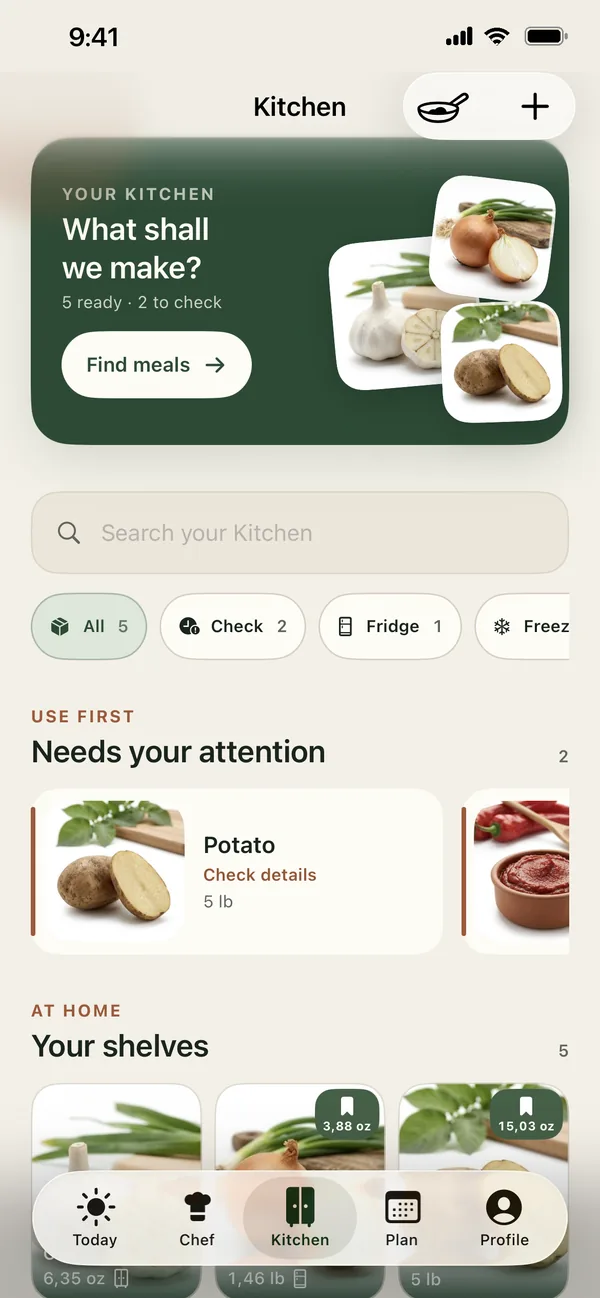
PantryWeave keeps track of what is in your fridge, freezer and pantry: for items with freshness tracking, freshness follows where they are stored, and the Use first shelf shows what to eat before it goes off.
What needs eating soon
Freshness checks with a Use first shelf show which ingredients need eating soon.
A week from what you have
You pick the recipes and plan your week; PantryWeave checks what you already have and builds the grocery list.
An estimate, not an official date
The app’s freshness check is an estimate, not a guarantee. The freezer and fridge times on this page come from the US government, the USDA, the National Center for Home Food Preservation and US university extension services. Always check the food itself too.
Where the advice comes from
The cold food storage chart was read on November 16, 2026; the other sources on November 17, 2026.
- National Center for Home Food Preservation (University of Georgia): freezing soup (February 1, 2013)
- Penn State Extension: let’s preserve soup (updated June 30, 2023: ingredients, cooling, freezing, serving frozen soup)
- Iowa State University Extension and Outreach, AnswerLine: freezing homemade soup (October 24, 2016; reviewed March 2026)
- US government cold food storage chart (soups and stews)
- USDA Food Safety and Inspection Service: chicken from farm to table (storage chart: chicken soup, broth or gravy)
- University of Illinois Extension: using leftovers (fridge times, soups)
- Pacific Northwest Extension: guide PNW612 on storing food (revised March 2023: Tables 2 and 4, soup and stew)
- University of Kentucky Cooperative Extension: recommended food storage times (FCS3-595, revised September 2026: cooked meats, casseroles, soups, stews)
Frequently asked questions
How long can you freeze soup?
The US government’s cold food storage chart gives soups and stews with vegetables or meat 2 to 3 months in the freezer and says its freezer times are for quality only; the USDA Food Safety and Inspection Service’s chicken storage chart gives cooked chicken casseroles, dishes or soup 4 to 6 months, and chicken broth or gravy 2 to 3 months, for quality only. The National Center for Home Food Preservation says frozen soup has its highest quality within 4 to 6 months. Iowa State University Extension’s AnswerLine says that, for the best flavor, dairy-based soups should be eaten within two months of freezing and broth-based soups within three months.
Can you freeze soup with potatoes or pasta?
Penn State Extension lists them among ingredients that do not freeze well: it says pasta, noodles and rice become mushy when frozen, and potatoes crumble and become mushy, though waxy potatoes freeze better than baking-type potatoes. The National Center for Home Food Preservation says it is generally suggested to leave potatoes out of soups you plan to freeze. Iowa State’s AnswerLine says potatoes and pasta may need special consideration.
Can you freeze soup in glass jars?
Yes, in jars made for it. The National Center for Home Food Preservation suggests rigid containers such as plastic cartons or glass jars designed for canning and freezing, says wide-mouth jars make it easier to remove the soup before it has completely thawed, and says not to put hot glass in the freezer, because it may break.
Do you need to thaw frozen soup before reheating it?
The sources differ. The National Center for Home Food Preservation recommends reheating soup straight from the freezer rather than thawing it, to a rolling boil or at least 165 °F. Iowa State’s AnswerLine says soups should be thawed in the refrigerator overnight. Penn State Extension gives both ways, and defrosting in the microwave, each followed by reheating to at least 165 °F (73 °C), and says not to thaw soup at room temperature.
Can you freeze cream soup?
The National Center for Home Food Preservation says to heat cream soups over boiling water, as in a double boiler, and to stir soups with dairy while reheating, because they may curdle and separate. Iowa State’s AnswerLine says dairy-based soups should be eaten within two months of freezing for the best flavor.
Related guides

Know what needs eating first
Download PantryWeave and see what you have in the fridge, freezer and pantry, and what needs using first.

Free to start · iPhone