
Food waste: how much food is wasted?
According to the FDA, food waste in the United States is estimated at between 30 and 40 percent of the food supply, based on USDA Economic Research Service estimates of food loss at the retail and consumer levels for 2010; the EPA estimates that about 66 million tons of wasted food were generated in the food retail, food service and residential sectors in 2019. Below: what the terms mean, the estimates by source, where wasted food goes, the national goal and wasting less at home.

Short answer: the EPA says food waste often refers to food not ultimately consumed by humans that is discarded or recycled, such as plate waste, spoiled food, or peels and rinds considered inedible. In the United States, food waste is estimated at between 30 and 40 percent of the food supply, according to the FDA; the figure is based on USDA Economic Research Service estimates of food loss at the retail and consumer levels and corresponded to approximately 133 billion pounds and $161 billion worth of food in 2010. The EPA estimates that about 66 million tons of wasted food were generated in the food retail, food service and residential sectors in 2019, and that most of it, about 60 percent, was sent to landfills.
What is food waste?
The EPA gives four terms. Food waste often refers to food not ultimately consumed by humans that is discarded or recycled, such as plate waste (food that has been served but not eaten), spoiled food, or peels and rinds considered inedible. Food loss often refers to unused product from the agricultural sector, such as unharvested crops. Excess food, or surplus food, often refers to food that is donated to feed people. Wasted food is the EPA’s overarching term for food that was not used for its intended purpose, and it can refer to both excess food and food waste.
The EPA says it uses “wasted food” instead of “food waste” because the term conveys that a valuable resource is being wasted, whereas “food waste” implies that the food no longer has value. For the purposes of Sustainable Development Goal Target 12.3, it says, food loss occurs from production up to (and not including) the retail level, and food waste occurs at the retail, food service and residential levels.
How much food is wasted in the US, by source
Each agency’s figures in its own words, with the year and the part of the food system they cover; where an agency cites another, the row says so.
| Source | Estimate | Year and scope |
|---|---|---|
| FDA, Food Loss and Waste | Between 30 and 40 percent of the food supply; approximately 133 billion pounds and $161 billion worth of food | 2010; based on USDA Economic Research Service estimates of food loss at the retail and consumer levels |
| EPA, Sustainable Management of Food Basics, citing the USDA | 31 percent, or 133 billion pounds of the 430 billion pounds of food available, not eaten; valued at almost $162 billion | 2010; retail and consumer levels |
| EPA, Sustainable Management of Food Basics | About 66 million tons of wasted food generated; about 60 percent sent to landfills | 2019; food retail, food service and residential sectors |
| EPA, citing the United Nations | Approximately one-third of all food produced for human consumption lost or wasted: 13 percent lost before reaching retail, 19 percent wasted from retail to consumer | Global; the EPA lists the UN Food and Agriculture Organization’s 2019 report and the UN Environment Programme’s Food Waste Index Report 2024 among its sources |
The FDA says its 2010 figure is based on USDA Economic Research Service estimates, and the EPA cites the USDA for its 2010 figure. The FDA gives the value as $161 billion, and the EPA as almost $162 billion. The EPA’s estimate of about 66 million tons for 2019 is its own, and it counts wasted food, the EPA’s overarching term.
Where does wasted food go?
The EPA estimates that most of the wasted food generated in the food retail, food service and residential sectors in 2019, about 60 percent, was sent to landfills. It says that in 2018 more food reached landfills and combustion facilities than any other single material in everyday trash, 24 percent of the amount landfilled and 22 percent of the amount combusted with energy recovery, and it estimates that wasted food is responsible for 58 percent of landfill methane emissions to the atmosphere; among its sources the EPA lists its 2023 report Quantifying Methane Emissions from Landfilled Food Waste.
The EPA’s Wasted Food Scale ranks what can be done with wasted food. The EPA says the most preferred pathways are to prevent wasted food, and to donate and upcycle food.
What is the US goal for food waste?
The FDA names a national food waste reduction goal: to reduce food waste by 50 percent by the year 2030. The FDA says that in May 2024 it signed a formal agreement with the USDA and the EPA renewing their Federal Interagency Collaboration to Reduce Food Loss and Waste, and that on June 12, 2024, the three agencies announced the National Strategy for Reducing Food Loss and Waste and Recycling Organics.
How can you waste less food at home?
The EPA says you can spend less and waste less by buying only the food you will use. Eight steps from US and UK government guidance, from checking what you have to using leftovers in time, are in our guide how to reduce food waste at home.
How PantryWeave keeps track of your kitchen
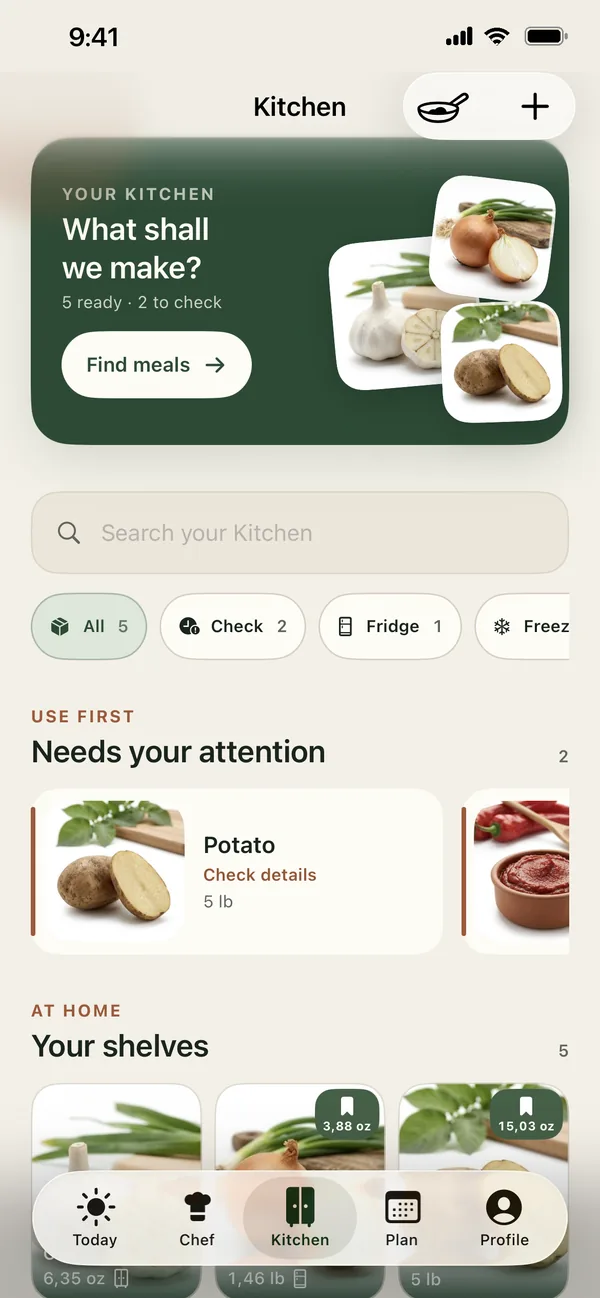
PantryWeave keeps track of your kitchen: it plans your meals from what is already in your Kitchen, and the stock stays current: when you mark a meal as cooked, you choose whether the app deducts its ingredients from Kitchen or keeps Kitchen unchanged.
For the waste a household can control, PantryWeave works as two tools in one: a pantry, fridge and freezer inventory that shows what you have, and a grocery list app that adds what your planned meals still need once Kitchen’s stock is subtracted.
Every item in its place
Kitchen shows whether each item belongs in the pantry, the fridge or the freezer.
Put the shopping away in one step
Put the shopping away in one step: tick what you buy in the store and send it straight to Kitchen, where each item lands in its pantry, fridge or freezer spot. You correct a quantity only if it differs from the list.
Tracked by where it is kept
Kitchen tracks each item’s freshness, or a suggested day to use it by, according to where you keep it, and the Use first shelf brings forward what needs eating soon.
A reminder, not a label date
Freshness in the app is an estimate meant as a reminder, not a label date.
Where the numbers come from
- FDA: Food Loss and Waste (content current as of January 13, 2025: the 30 to 40 percent estimate, the 2024 interagency agreement and national strategy, the 2030 goal; read on November 19, 2026)
- EPA: Sustainable Management of Food Basics (last updated August 19, 2026: the terms, the 2019 and 2018 estimates, the USDA and United Nations figures it cites, landfill methane, the Wasted Food Scale; read on November 19, 2026)
Frequently asked questions
What is food waste?
The EPA says food waste often refers to food not ultimately consumed by humans that is discarded or recycled, such as plate waste (food that has been served but not eaten), spoiled food, or peels and rinds considered inedible. The EPA uses the overarching term “wasted food” for food that was not used for its intended purpose; the term can refer to both excess food and food waste.
How much food is wasted in the US?
The FDA says food waste in the United States is estimated at between 30 and 40 percent of the food supply; the figure is based on USDA Economic Research Service estimates of food loss at the retail and consumer levels and corresponded to approximately 133 billion pounds and $161 billion worth of food in 2010. The EPA estimates that about 66 million tons of wasted food were generated in the food retail, food service and residential sectors in 2019.
What is the difference between food loss and food waste?
In the EPA’s words, food loss often refers to unused product from the agricultural sector, such as unharvested crops, and for the purposes of Sustainable Development Goal Target 12.3 it occurs from production up to (and not including) the retail level. Food waste, for the same purposes, occurs at the retail, food service and residential levels.
Where does wasted food go?
The EPA estimates that most of the wasted food generated in the food retail, food service and residential sectors in 2019, about 60 percent, was sent to landfills. It says that in 2018 more food reached landfills and combustion facilities than any other single material in everyday trash: 24 percent of the amount landfilled and 22 percent of the amount combusted with energy recovery.
Related guides

Know what needs using first
Download PantryWeave and see what is in your fridge, freezer and pantry, and what needs using first.

Free to start · iPhone