
Can you freeze stuffing?
Yes, you can freeze stuffing cooked or uncooked. How long it keeps, how the USDA says to freeze it before baking, and how to thaw and reheat it, each from its source.

Short answer: Yes. Oregon State University Extension says to use leftover turkey, stuffing and gravy within 3 to 4 days for best quality or freeze them for 2 to 6 months. For stuffing made ahead, the USDA Food Safety and Inspection Service says the ingredients can be combined, put into a shallow container and frozen immediately; it says not to thaw it before cooking and to cook the frozen stuffing until it reaches 165 °F. For the rest of the holiday food, see how long Thanksgiving leftovers are good for.
How long frozen stuffing keeps, by source
In each source’s own terms. Only Oregon State University Extension gives a freezer time for stuffing itself; the USDA’s freezer time is for leftovers in general.
| Source | What it says |
|---|---|
| Oregon State University Extension, Turkey basics | Leftover turkey, stuffing and gravy: use within 3 to 4 days for best quality, or freeze them for 2 to 6 months |
| USDA Food Safety and Inspection Service, stuffing | Stuffing taken out of the bird: use or freeze it within 3 to 4 days |
| USDA Food Safety and Inspection Service, leftovers | Leftovers in general: 3 to 4 days in the refrigerator or 3 to 4 months in the freezer; frozen leftovers can lose moisture and flavor when stored for longer times |
| University of Illinois Extension, chart for leftovers | Stuffing: 1 to 2 days in the refrigerator (no freezer time) |
None of these sources gives a freezer time for uncooked stuffing frozen ahead; the USDA Food Safety and Inspection Service says to freeze it immediately and cook it from frozen. Freeze leftover stuffing while it is still within its fridge time: after a Thursday meal, the University of Illinois Extension’s 1 to 2 days end on Friday or Saturday (our arithmetic, not the University of Illinois Extension’s), and the USDA Food Safety and Inspection Service’s 3 to 4 days on Sunday or Monday.
How to freeze leftover stuffing
- Take it out of the bird: for stuffing cooked in whole poultry, the USDA Food Safety and Inspection Service says to remove all stuffing from the cavity and place it in a sealed container. It says: “USDA does not recommend refrigerating a whole, cooked turkey with stuffing inside.”
- Cool it in shallow containers: the USDA Food Safety and Inspection Service says to cool cooked stuffing in shallow containers and refrigerate it within 2 hours.
- Wrap it well: it says to cover leftovers, wrap them in airtight packaging or seal them in storage containers: “These practices help keep bacteria out, retain moisture, and prevent leftovers from picking up odors from other food in the refrigerator.”
- Freeze it in time: the USDA Food Safety and Inspection Service says to use or freeze leftover stuffing within 3 to 4 days.
Can you freeze stuffing before baking it?
Yes. For stuffing made ahead, freezing is one of the two ways the USDA Food Safety and Inspection Service gives: “Do not refrigerate uncooked stuffing. If stuffing is prepared ahead of time, it must be either frozen or cooked immediately.”
- Mix and freeze at once: it says the ingredients can be combined, put into a shallow container and frozen immediately.
- Cook it from frozen: the USDA Food Safety and Inspection Service says not to thaw it before cooking, and to cook the frozen stuffing until it reaches 165 °F. For stuffing in a casserole, the USDA Food Safety and Inspection Service gives an oven set no lower than 325 °F.
- Not in the slow cooker: it says: “NOTE: Never place frozen stuffing or other frozen food in a slow cooker.”
- Not back into a bird: it says: “Do not stuff whole poultry with leftover cooked stuffing.”
If you would rather not freeze it, the same agency says the dry and wet ingredients can be prepared ahead of time and chilled, as long as they are not mixed until just before the stuffing goes into the bird or the casserole. All the ways to get ahead are in making stuffing the day before.
Freezing celery and onions for stuffing
The National Center for Home Food Preservation at the University of Georgia says celery loses its crispness when frozen and that the frozen product “is suitable only for cooked dishes,” such as a baked stuffing. The National Center for Home Food Preservation’s steps: cut the stalks into 1-inch lengths, water blanch them for 3 minutes, cool them promptly, drain and package them leaving no headspace, then seal and freeze. More in our guide to freezing celery.
For diced onions, the National Center for Home Food Preservation says to dice them into about 1/4-inch pieces with no blanching, and to pack them dry into freezer bags or containers leaving 1/2-inch headspace, or to freeze the pieces on a tray before packaging. It says onions frozen this way are best used within a few months.
To get ahead by only a day, Nebraska Extension says to keep wet and dry ingredients separate, to chill all of the wet ingredients, such as butter, cooked celery and onions and broth, and to mix them just before filling the turkey.
Thawing and reheating frozen stuffing
Uncooked stuffing frozen ahead is cooked from frozen, as above. For cooked stuffing, the USDA Food Safety and Inspection Service gives these ways for leftovers:
- In the refrigerator: the USDA Food Safety and Inspection Service says refrigerator thawing takes the longest, and that after thawing the food should be used within 3 to 4 days or can be refrozen.
- In cold water: it says the frozen leftovers must be in a leak-proof package or plastic bag, and that foods thawed this way should be cooked before refreezing.
- In the microwave: the USDA Food Safety and Inspection Service says to continue heating the leftovers until they reach 165 °F on a food thermometer.
The USDA Food Safety and Inspection Service says leftover stuffing may be reheated in the microwave or in an oven set no lower than 325 °F, with a food thermometer to make sure the center reaches 165 °F. Step by step, and why not the slow cooker, in how to reheat stuffing.
How PantryWeave keeps track of the freezer
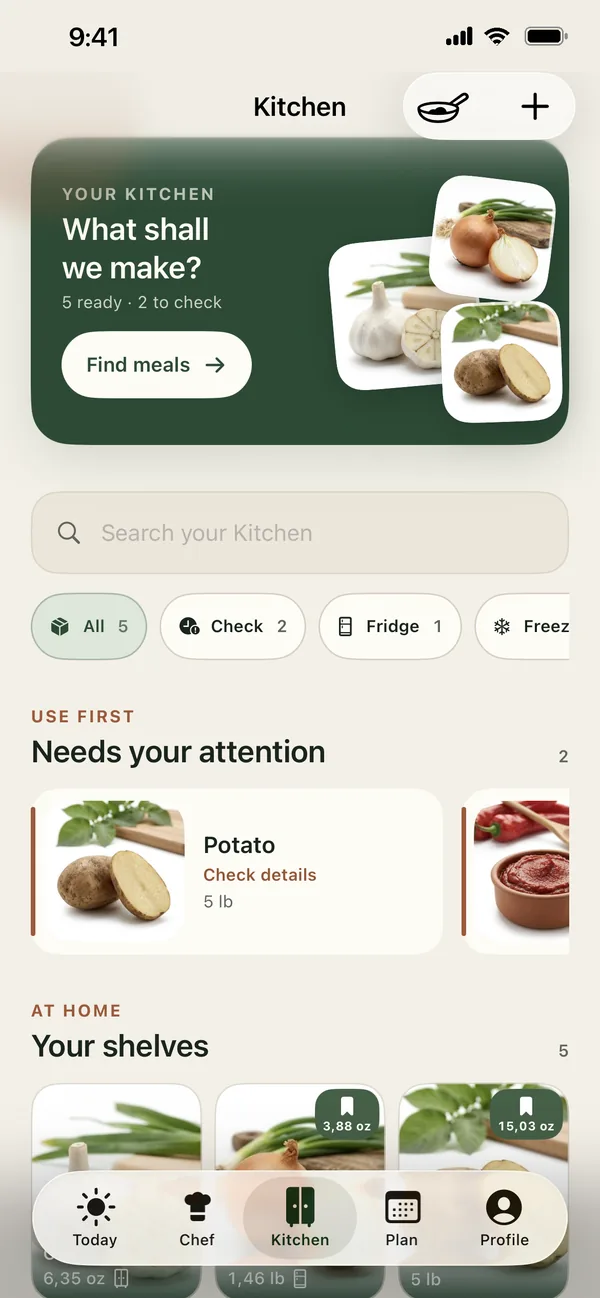
PantryWeave, the weekly meal planner for iPhone, which also runs on iPad, shows what is in the freezer next to what is in the fridge and the pantry.
Frozen is counted as frozen
Kitchen keeps Fridge, Freezer, Pantry and Counter apart. When you move an item to Freezer, freshness tracking switches off for it.
Check before you buy
“Search your Kitchen” finds the bread, celery or broth you already have before the next batch of stuffing goes on the list.
Side dishes from what is at home
Choose a side dish under “What are we preparing?” and Chef starts from what is already at home, checking each recipe against the allergens, diets and foods to avoid of the people you choose in “Who is eating?”.
Only what is missing
Plan the meal and the shopping list holds only what is missing; what you have shows as “Already in Kitchen”.
Where the advice comes from
The university extension pages were read on November 20, 2026. The USDA Food Safety and Inspection Service pages were read from Internet Archive copies made on November 19, 2026 (leftovers) and November 18, 2026 (stuffing); they were last updated on July 31, 2020 (leftovers) and August 2, 2013 (stuffing). Outside the US, follow your local food authority’s advice.
- Oregon State University Extension: Turkey basics (SP 50-1000, revised October 2026: turkey, stuffing and gravy in the fridge and the freezer)
- USDA Food Safety and Inspection Service: stuffing (removing stuffing from the bird, cooling, using or freezing within 3 to 4 days, uncooked stuffing frozen ahead, the slow cooker, reheating)
- USDA Food Safety and Inspection Service: leftovers (wrapping, freezer time for leftovers in general, thawing)
- University of Illinois Extension: Using leftovers (stuffing in the refrigerator)
- Nebraska Extension: Turkey 101 (wet and dry ingredients prepared ahead)
- National Center for Home Food Preservation: freezing celery and freezing onions (University of Georgia; adapted from So Easy to Preserve, 6th edition, 2014)
Frequently asked questions
Can you freeze stuffing?
Yes. Oregon State University Extension says to use leftover turkey, stuffing and gravy within 3 to 4 days for best quality or freeze them for 2 to 6 months. The USDA Food Safety and Inspection Service says uncooked stuffing ingredients can be combined, put into a shallow container and frozen immediately, then cooked from frozen until the stuffing reaches 165 °F.
Can you freeze celery and onions for stuffing?
Yes, for a cooked stuffing. The National Center for Home Food Preservation says celery loses its crispness when frozen and is suitable only for cooked dishes; it says to cut it into 1-inch lengths and blanch it for 3 minutes before freezing. For diced onions, it says no blanching is required and that they are best used within a few months.
Related guides

See what is in your freezer before you shop
Download PantryWeave to keep the freezer, the fridge and the pantry in one Kitchen and plan the next meals from what is there.

Free to start · iPhone