
How to reheat stuffing
How to reheat stuffing from the fridge or the freezer, in the oven or the microwave, with the temperature to reach from the USDA and university extension services, and how to get it ready the day before.

Short answer: In the oven or the microwave. The USDA Food Safety and Inspection Service says leftover stuffing may be reheated in the microwave or in an oven set no lower than 325 °F, with a food thermometer to make sure the center of the stuffing reaches 165 °F, and that leftovers should not be reheated in a slow cooker. Oregon State University Extension says to reheat leftovers to 165 °F or until hot and steaming.
In the oven
The USDA Food Safety and Inspection Service gives an oven set no lower than 325 °F for leftover stuffing. For leftovers in general, it says to cover them while they reheat: “This retains moisture and ensures that food will heat all the way through.”
None of the sources on this page gives an oven time for stuffing, so the check is the thermometer: the USDA Food Safety and Inspection Service says the center of the stuffing should reach 165 °F.
In the microwave
The USDA Food Safety and Inspection Service gives these microwave steps for leftovers:
- Arrange the food evenly in a covered glass or ceramic dish made for the microwave, and add some liquid if needed.
- Vent the lid or wrap to let the steam escape.
- Cover and rotate the food for even heating.
- Because microwaves have cold spots, check the temperature in several places with a food thermometer, and allow a resting time before checking.
For stuffing, the USDA Food Safety and Inspection Service says the center should reach 165 °F.
Why not in the slow cooker
The USDA Food Safety and Inspection Service says leftovers should not be reheated in a slow cooker due to the length of time it takes for the leftover food to pass through the “Danger Zone,” the temperatures between 40 °F and 140 °F. The USDA Food Safety and Inspection Service says to reheat the stuffing in an oven set no lower than 325 °F or in a microwave oven, and that once reheated, leftover stuffing may be served in a preheated slow cooker on the buffet.
The USDA Food Safety and Inspection Service’s slow cooker page says cooked food should be reheated on the stove, in a microwave or in a conventional oven until it reaches 165 °F, and that the hot food can then be placed in a preheated slow cooker to keep it hot for serving, at least 140 °F as measured with a food thermometer.
Reheating stuffing from the freezer
- Cooked stuffing, frozen: if you thaw it in the microwave, the USDA Food Safety and Inspection Service says to continue heating it until it reaches 165 °F.
- Uncooked stuffing, frozen ahead: the USDA Food Safety and Inspection Service says not to thaw it before cooking and to cook the frozen stuffing until it reaches 165 °F.
- Never in the slow cooker from frozen: it says: “NOTE: Never place frozen stuffing or other frozen food in a slow cooker.”
Freezer times and thawing are in our guide to freezing stuffing.
How long leftover stuffing keeps before you reheat it
The University of Illinois Extension’s chart for leftovers gives stuffing 1 to 2 days in the fridge. The USDA Food Safety and Inspection Service says to cool cooked stuffing in shallow containers, refrigerate it within 2 hours and use it within 3 to 4 days; Oregon State University Extension says to use leftover turkey, stuffing and gravy within 3 to 4 days for best quality. If the stuffing was cooked in the bird, Nebraska Extension says to make sure to remove all stuffing from the turkey cavities.
Fridge times for the other dishes on the table are in how long Thanksgiving leftovers are good for, and ideas for what is left, from a crisp stuffing waffle to a casserole topping, are in our Thanksgiving leftovers plan.
Can you make stuffing the day before?
Not as a mixed, uncooked stuffing in the fridge. The USDA Food Safety and Inspection Service says: “Stuffing should not be prepared ahead. The dry and wet ingredients for stuffing can be prepared ahead of time and chilled. However, do not mix wet and dry ingredients until just before spooning the stuffing mixture into a poultry cavity, in/on other meat, or into a casserole.” It also says: “Do not refrigerate uncooked stuffing.” That leaves three ways to get ahead:
- Prepare the parts the night before: the USDA Food Safety and Inspection Service says the dry and wet ingredients can be prepared ahead of time and chilled, and mixed just before the stuffing goes into the casserole. Oregon State University Extension says the dry ingredients can be mixed together and chilled ahead of time, with the liquids mixed in just before; Nebraska Extension says to chill all of the wet ingredients, such as butter, cooked celery and onions and broth.
- Bake it the day before and reheat it: the USDA Food Safety and Inspection Service says to cool cooked stuffing in shallow containers, refrigerate it within 2 hours, use it within 3 to 4 days and reheat it to 165 °F.
- Mix it and freeze it at once: the USDA Food Safety and Inspection Service says stuffing prepared ahead must be either frozen or cooked immediately; see freezing stuffing before baking it.
On the day, Oregon State University Extension says to bake the stuffing in a covered, greased baking dish, starting 1 to 2 hours before the end of the turkey roasting time, until it reaches 165 °F.
How PantryWeave turns the leftovers into the next meals
PantryWeave, the weekly meal planner for iPhone, which also runs on iPad, starts the days after Thanksgiving from what is still in the fridge.
- Find a dish that uses what you have. In Chef, pick a side dish or dinner under “What are we preparing?” and set “How much shopping?” to Nothing extra: the suggestions use what is already at home and are matched to the people you choose in “Who is eating?” and to your kitchen equipment.
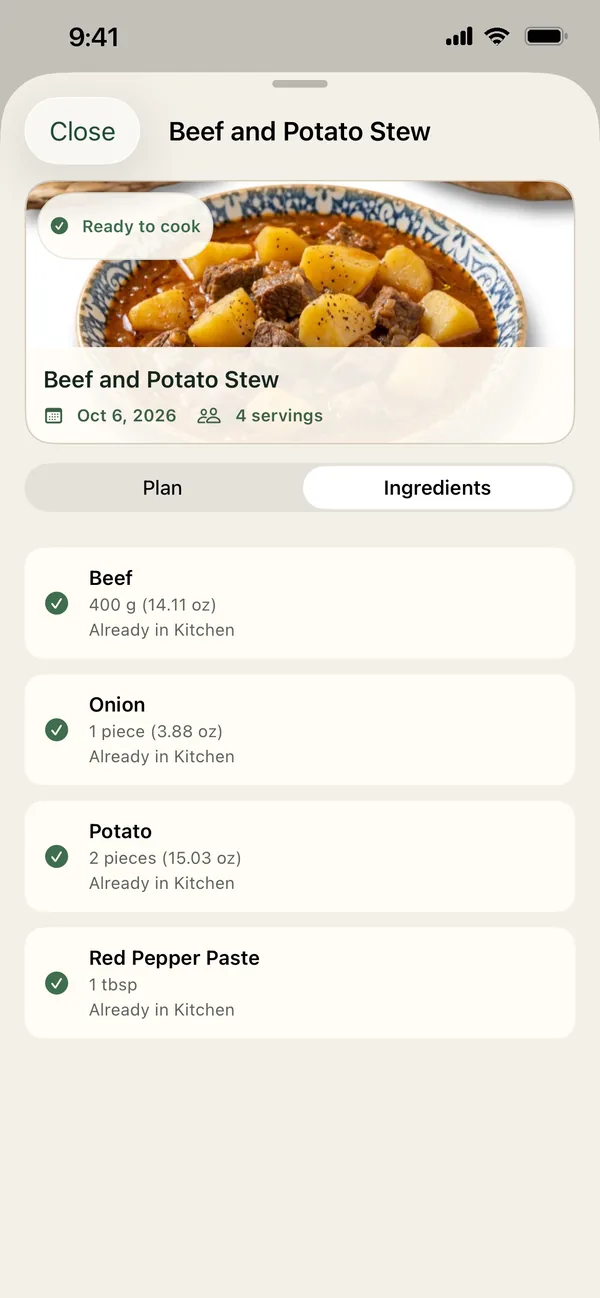
- See what is missing. A recipe shows every ingredient and step, what is not in Kitchen yet, and a card for each person in the household.
- Keep Kitchen up to date. When you finish cooking, “Cooked — deduct Kitchen” takes the ingredients you used off what you have.
- Plan the rest of the week. Add the meal to your plan, and the shopping list fills in only what is still missing.
Where the advice comes from
The university extension pages were read on November 20, 2026. The USDA Food Safety and Inspection Service pages were read from Internet Archive copies made on November 19, 2026 (leftovers and slow cookers) and November 18, 2026 (stuffing); they were last updated on July 31, 2020 (leftovers), August 2, 2013 (stuffing) and August 8, 2013 (slow cookers). Outside the US, follow your local food authority’s advice.
- USDA Food Safety and Inspection Service: stuffing (reheating leftover stuffing, the slow cooker, preparing stuffing ahead, uncooked stuffing frozen ahead)
- USDA Food Safety and Inspection Service: leftovers (covering, the microwave steps, heating after microwave thawing)
- USDA Food Safety and Inspection Service: slow cookers (reheating first, then keeping food hot for serving)
- Oregon State University Extension: Turkey basics (SP 50-1000, revised October 2026: reheating to 165 °F, dry ingredients chilled ahead, baking the stuffing on the day)
- Nebraska Extension: Turkey 101 (wet ingredients chilled ahead, removing stuffing from the bird)
- University of Illinois Extension: Using leftovers (stuffing in the refrigerator)
Frequently asked questions
Can I make stuffing the day before?
The USDA Food Safety and Inspection Service says the dry and wet ingredients can be prepared ahead of time and chilled, and mixed only just before the stuffing goes into the casserole. It also says stuffing prepared ahead must be either frozen or cooked immediately, and that cooked stuffing is refrigerated within 2 hours and reheated to 165 °F.
Related guides

Cook the next meal from what is left
Download PantryWeave, find recipes that use what is already in your Kitchen and plan the rest of the week around them.

Free to start · iPhone