


Can you freeze cooked rice?
Yes. The USDA’s FoodKeeper gives cooked rice 6 months in the freezer; Nebraska Extension says frozen rice is best if used within 2 months. Below: each source’s freezer time side by side, how to freeze cooked rice, and how to thaw and reheat it.

Short answer: Yes. The USDA’s FoodKeeper gives cooked rice 6 months in the freezer, and Iowa State University Extension and Outreach’s Spend Smart Eat Smart, citing its AnswerLine, says up to 6 months. Nebraska Extension says frozen rice is best if used within 2 months, and FoodKeeper’s row for leftovers without meat, such as cooked rice, gives 1 to 2 months. How long cooked rice keeps in the fridge, under US and UK advice, is in our guide how long does rice last in the fridge?
Cooked rice in the fridge and the freezer, by source
Each source’s own row, in its own words; a dash means we give no time from that source there.
| Source and row | Fridge | Freezer |
|---|---|---|
| The USDA’s FoodKeeper: cooked rice | 4 to 6 days | 6 months |
| The USDA’s FoodKeeper: leftovers without meat, fish, poultry or egg (such as cooked vegetables, rice or potatoes) | 3 to 4 days | 1 to 2 months |
| Nebraska Extension: cooked rice | 3 to 4 days, for reheated leftovers | Best if used within 2 months |
| Iowa State University Extension and Outreach, Spend Smart Eat Smart, citing AnswerLine: cooked rice | 4 to 6 days | Up to 6 months |
| N.C. Cooperative Extension (Brunswick County): cooked rice | — | If you do freeze it, try to eat within six months for best quality |
| The NHS (UK): cooked rice not eaten immediately | Refrigerate within 1 hour and eat within 24 hours | — |
FoodKeeper has two rows that cover cooked rice: its own cooked rice row, and a row for leftovers without meat, fish, poultry or egg that names cooked rice as an example. Our guide how long does rice last in the fridge? gives the cooked rice row; our guide how long pantry staples keep says the USDA gives cooked rice 3 to 4 days in the fridge, the same as FoodKeeper’s leftovers row. Iowa State’s times are the same as FoodKeeper’s cooked rice row, and Nebraska Extension lists the USDA’s FoodKeeper among its sources. The NHS gives no freezer time for rice.
How do you freeze cooked rice?
Nebraska Extension says this method works with brown and white rice, and gives these steps:
- Spread it out: cook rice according to package directions and, while hot, spread rice evenly on a baking sheet or in shallow freezer containers.
- Cool it: let rice cool about 20 minutes. If using a baking sheet, scoop rice into plastic freezer bags or freezer containers.
- Label and seal: label each bag or container with the date, type and amount of rice. If freezer bags are used, remove the air, press so contents lay flat for easier storage, and seal.
Iowa State’s Spend Smart Eat Smart, citing AnswerLine, says to store cooked, cooled rice in an airtight container in the refrigerator or freezer. The NHS says that if you are not going to eat cooked rice immediately, refrigerate it within 1 hour and eat it within 24 hours.
How do you thaw and reheat frozen rice?
Nebraska Extension gives steps for reheating frozen rice in the microwave, and for adding it frozen directly to dishes such as soups or stews; the Food Standards Agency says to defrost food in the fridge.
- In the microwave: Nebraska Extension says rice will freeze as a solid block: break it into chunks and place them in a bowl made for the microwave, cover the bowl with a lid made for the microwave or with plastic wrap, and microwave on high just until hot. Time will vary with the amount of rice and the microwave’s wattage.
- Keeping it moist: reheated frozen rice tends to dry out quickly, Nebraska Extension says; use it immediately, and reheating it with a tablespoon or two of water or with added vegetables will help provide moisture.
- Straight into a dish: frozen rice can be added directly to dishes, and this works best in soups or stews, where it defrosts and heats in the liquid, Nebraska Extension says.
- In the fridge: the Food Standards Agency says to defrost food in the fridge and to use it within 24 hours after it has fully defrosted.
Does cooked rice freeze well?
N.C. Cooperative Extension (Brunswick County), citing the National Center for Home Food Preservation, says cooked rice is one of those foods that does not freeze well: it tends to get mushy and tastes warmed over. Nebraska Extension, for its part, suggests making extra rice to freeze for later use, and says frozen cooked rice can go into leftovers, batch cooking or slow cooker meals.
How PantryWeave keeps track of your kitchen
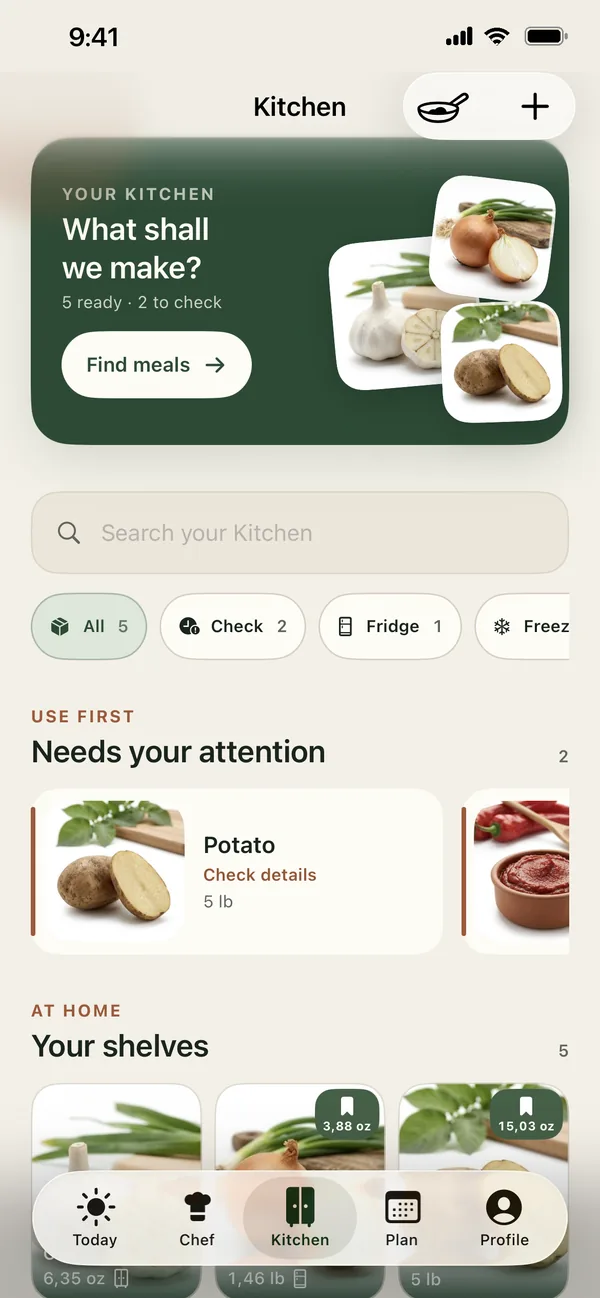
PantryWeave keeps track of your kitchen: it plans your meals from what is already in your Kitchen, and the stock stays current: when you mark a meal as cooked, you choose whether the app deducts its ingredients from Kitchen or keeps Kitchen unchanged.
Every item in its place
Kitchen shows whether each item belongs in the pantry, the fridge or the freezer.
Put the shopping away in one step
Put the shopping away in one step: tick what you buy in the store and send it straight to Kitchen, where each item lands in its pantry, fridge or freezer spot. You correct a quantity only if it differs from the list.
Tracked by where it is kept
Kitchen tracks each item’s freshness, or a suggested day to use it by, according to where you keep it, and the Use first shelf brings forward what needs eating soon.
A reminder, not a label date
Freshness in the app is an estimate meant as a reminder, not a label date. The rice times on this page come from university extension services, the USDA’s FoodKeeper, the NHS and the Food Standards Agency, and checking the food itself still matters.
Where the times come from
All sources read on November 18, 2026.
- USDA FoodKeeper (cooked rice; leftovers without meat, fish, poultry or egg; FoodKeeper data file, version 128, as archived on July 2, 2025; read on November 18, 2026)
- Nebraska Extension: freezing rice and pasta (written in 2022: freezing steps, frozen rice best if used within 2 months, reheating; read on November 18, 2026)
- Iowa State University Extension and Outreach, Spend Smart Eat Smart: extra rice? (April 10, 2023, citing AnswerLine: cooked rice in the refrigerator and freezer; read on November 18, 2026)
- N.C. Cooperative Extension, Brunswick County Center: leftover rice (February 19, 2024, updated March 17, 2025, citing the National Center for Home Food Preservation: freezing cooked rice; read on November 18, 2026)
- NHS: storing and reheating rice (last reviewed March 15, 2023: cooked rice in the fridge; read on November 18, 2026)
- Food Standards Agency: chilling, freezing and defrosting (published December 18, 2017; guidance for England, Wales and Northern Ireland: defrosting, 24 hours after defrosting; read on November 18, 2026)
Frequently asked questions
Can you freeze cooked rice?
Yes. The USDA’s FoodKeeper gives cooked rice 6 months in the freezer. Nebraska Extension says frozen rice is best if used within 2 months, and FoodKeeper’s row for leftovers without meat, such as cooked rice, gives 1 to 2 months.
How long does cooked rice last in the freezer?
By source: the USDA’s FoodKeeper gives cooked rice 6 months, and its row for leftovers without meat, fish, poultry or egg gives 1 to 2 months; Iowa State University Extension and Outreach’s Spend Smart Eat Smart, citing its AnswerLine, says up to 6 months; N.C. Cooperative Extension says that if you do freeze it, try to eat it within six months for best quality; Nebraska Extension says frozen rice is best if used within 2 months.
How do you freeze cooked rice?
Nebraska Extension says to spread the hot rice evenly on a baking sheet or in shallow freezer containers, let it cool about 20 minutes and, if using a baking sheet, scoop it into plastic freezer bags or freezer containers. Then label each bag or container with the date, type and amount of rice and, for bags, remove the air, press them flat and seal.
How do you reheat frozen rice?
Nebraska Extension says rice freezes as a solid block: break it into chunks in a bowl made for the microwave, cover it and microwave on high just until hot. It adds that reheated frozen rice tends to dry out quickly, and that a tablespoon or two of water or added vegetables help provide moisture.
Does cooked rice freeze well?
N.C. Cooperative Extension, citing the National Center for Home Food Preservation, says cooked rice is one of those foods that does not freeze well: it tends to get mushy and tastes warmed over.
Related guides

Know what needs using first
Download PantryWeave and see what is in your fridge, freezer and pantry, and what needs using first.

Free to start · iPhone