
Does baking powder go bad?
The USDA’s FoodKeeper gives baking powder 6 to 18 months in the pantry from the date of purchase and 3 to 6 months after opening; Utah State University Extension says that, kept free of moisture and contamination, it has an indefinite shelf life, and gives a warm-water test for opened baking powder. Below: the times side by side, the test, storage, and baking soda.

Short answer: The USDA’s FoodKeeper gives baking powder 6 to 18 months in the pantry from the date of purchase and 3 to 6 months after opening. Utah State University Extension says baking powder has an indefinite shelf life when kept free of moisture and contamination, and that once opened it will last for approximately 6 months. To check an opened can, it says to mix 1 teaspoon in 1/3 cup of warm water: if bubbles form, there is activity left. Other pantry staples are in our guide how long pantry staples keep.
How long baking powder keeps, by source
Each source’s own words.
| Source and row | Shelf life | After opening |
|---|---|---|
| The USDA’s FoodKeeper: baking powder (baked goods, baking and cooking) | 6 to 18 months in the pantry, from the date of purchase | 3 to 6 months in the pantry, after opening |
| Utah State University Extension: baking powder | Indefinite shelf life when kept free of moisture and contamination; a best-if-used-by date of 18 to 24 months | Approximately 6 months |
Utah State also cites a Brigham Young University study that examined the leavening power of baking powders stored for up to 29 years in their original cans: all samples successfully leavened biscuits, it says. Our guide how long pantry staples keep gives the same FoodKeeper times for baking powder.
How can you tell if baking powder is still good?
Utah State University Extension gives this test for opened baking powder: mix 1 teaspoon in 1/3 cup of warm water. If bubbles form, there is activity left in the baking powder.
How should you store baking powder?
- In its can: Utah State University Extension says to store baking powder in its original sealed can.
- Away from moisture: moisture can rapidly deteriorate it, Utah State says: baking powder and baking soda will react and chemically change with moisture. Once opened, it says to store them away from moisture.
- Heat and cold: Utah State says: “Temperature extreme will have less of a negative impact compared to moisture. These food items can freeze without harm. Excessive heat may lead to deterioration.”
What is the difference between baking powder and baking soda?
North Dakota State University (NDSU) Extension explains that baking soda, chemically known as sodium bicarbonate, requires an acidic ingredient to produce carbon dioxide, and that baking powder is a mixture of baking soda and a powdered acid. Double-acting baking powder, it says, contains two types of acids: it begins its leavening action immediately and again when the mixture is heated. NDSU adds that baking soda has four times the leavening power of baking powder, and that you cannot swap baking powder for baking soda.
The USDA’s FoodKeeper gives baking soda 2 to 3 years from the date of purchase and 6 months once opened; that row is in our guide how long pantry staples keep. A baking powder swap made from baking soda and cream of tartar is in our guide ingredient substitutes: what to use when you run out.
How PantryWeave keeps track of your kitchen
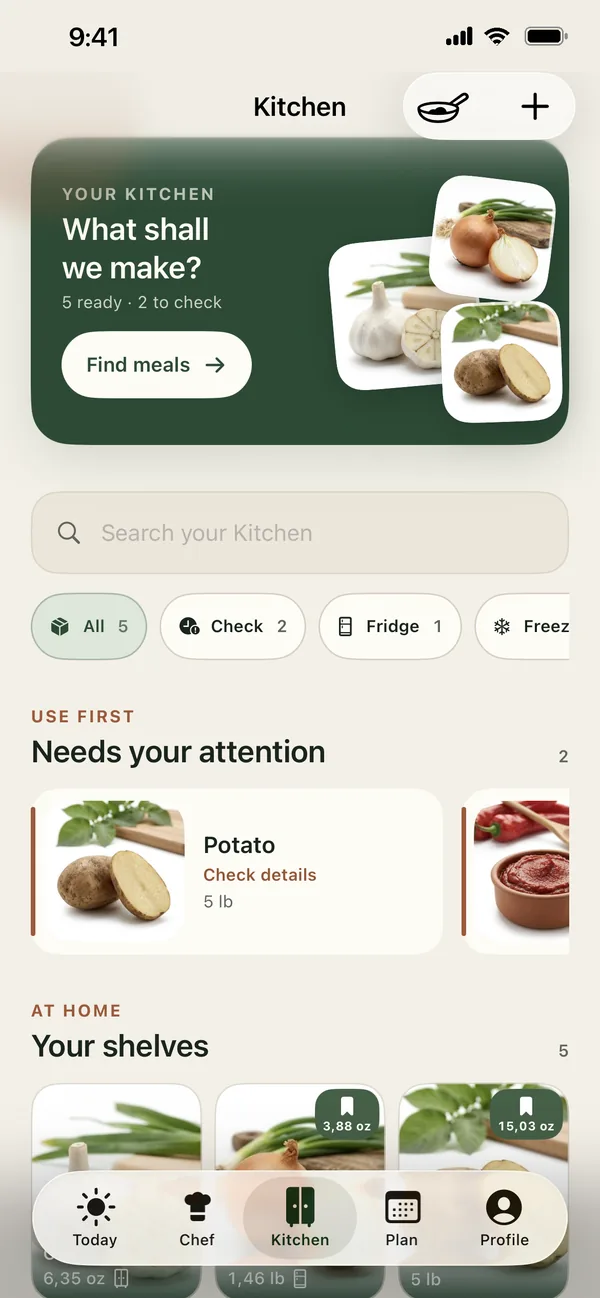
PantryWeave keeps track of your kitchen: it plans your meals from what is already in your Kitchen, and the stock stays current: when you mark a meal as cooked, you choose whether the app deducts its ingredients from Kitchen or keeps Kitchen unchanged.
Every item in its place
Kitchen shows whether each item belongs in the pantry, the fridge or the freezer.
Put the shopping away in one step
Put the shopping away in one step: tick what you buy in the store and send it straight to Kitchen, where each item lands in its pantry, fridge or freezer spot. You correct a quantity only if it differs from the list.
Tracked by where it is kept
Kitchen tracks each item’s freshness, or a suggested day to use it by, according to where you keep it, and the Use first shelf brings forward what needs eating soon.
A reminder, not a label date
Freshness in the app is an estimate meant as a reminder, not a label date. The baking powder times on this page come from the USDA’s FoodKeeper and Utah State University Extension, and checking the food itself still matters.
Where the times come from
All sources read on November 18, 2026.
- USDA FoodKeeper (baking powder; baking soda; FoodKeeper data file, version 128, as archived on July 2, 2025; read on November 18, 2026)
- Utah State University Extension: cooking food storage (undated: shelf life, storage, the warm-water test, the Brigham Young University study; read on November 18, 2026)
- North Dakota State University (NDSU) Extension, Prairie Fare: add to the levity of baking with these tips (December 12, 2013: baking powder and baking soda; read on November 18, 2026)
Frequently asked questions
Does baking powder go bad?
The USDA’s FoodKeeper gives baking powder 6 to 18 months in the pantry from the date of purchase and 3 to 6 months after opening. Utah State University Extension says baking powder has an indefinite shelf life when kept free of moisture and contamination, and that once opened it will last for approximately 6 months.
How can you tell if baking powder is still good?
Utah State University Extension says to mix 1 teaspoon of opened baking powder in 1/3 cup of warm water: if bubbles form, there is activity left in the baking powder.
How long does baking powder last once opened?
The USDA’s FoodKeeper gives 3 to 6 months after opening; Utah State University Extension says approximately 6 months.
How should you store baking powder?
Utah State University Extension says to store baking powder in its original sealed can and, once opened, away from moisture: baking powder and baking soda will react and chemically change with moisture.
Are baking soda and baking powder interchangeable?
North Dakota State University (NDSU) Extension says you cannot swap baking powder for baking soda. It explains that baking soda needs an acidic ingredient to produce carbon dioxide, and that baking soda has four times the leavening power of baking powder. A swap for baking powder that pairs baking soda with cream of tartar is in our guide ingredient substitutes: what to use when you run out.
Related guides

Know what needs using first
Download PantryWeave and see what is in your fridge, freezer and pantry, and what needs using first.

Free to start · iPhone