
Can you freeze cabbage?
Yes, as a cooked vegetable, but not for raw coleslaw. Here is how to cut, blanch and pack cabbage and Chinese cabbage, how long it keeps at 0 °F (−18 °C), and why raw coleslaw does not freeze well, from the National Center for Home Food Preservation.

Short answer: Yes, as a cooked vegetable. The National Center for Home Food Preservation (NCHFP) says frozen cabbage and Chinese cabbage are suitable for use only as a cooked vegetable. Cut the head into medium to coarse shreds or thin wedges, or separate the leaves, blanch them in boiling water for 1½ minutes, cool them quickly, drain, and pack them with ½ inch (about 1.3 cm) of headspace. The NCHFP gives fruits and vegetables in general about 8 to 12 months of best quality at 0 °F (−18 °C).
How to freeze cabbage, step by step
- Choose freshly picked, solid heads.
- Trim off the coarse outer leaves.
- Cut the head into medium to coarse shreds or thin wedges, or separate it into leaves.
- Blanch in boiling water for 1½ minutes.
- Cool promptly, then drain.
- Pack into freezer containers or bags, leaving ½ inch (about 1.3 cm) of headspace, then seal and freeze.
Blanching means scalding vegetables in boiling water or steam for a short time. The NCHFP says it stops the enzyme actions that cause loss of flavor, color, texture and nutrients, even in frozen storage. Its blanching table gives shredded cabbage or Chinese cabbage 1½ minutes.
Freezing cabbage at a glance
Every row comes from the National Center for Home Food Preservation. The storage time is its general figure for fruits and vegetables, not a time for cabbage alone.
| Step | What to do |
|---|---|
| Use after freezing | As a cooked vegetable only |
| Cut | Medium to coarse shreds, thin wedges or single leaves |
| Blanch | 1½ minutes in boiling water |
| Cool | Promptly, then drain |
| Pack | ½ inch (about 1.3 cm) of headspace; seal |
| Freezer | 0 °F (−18 °C) or below |
| Best quality | About 8 to 12 months |
How PantryWeave helps you keep track
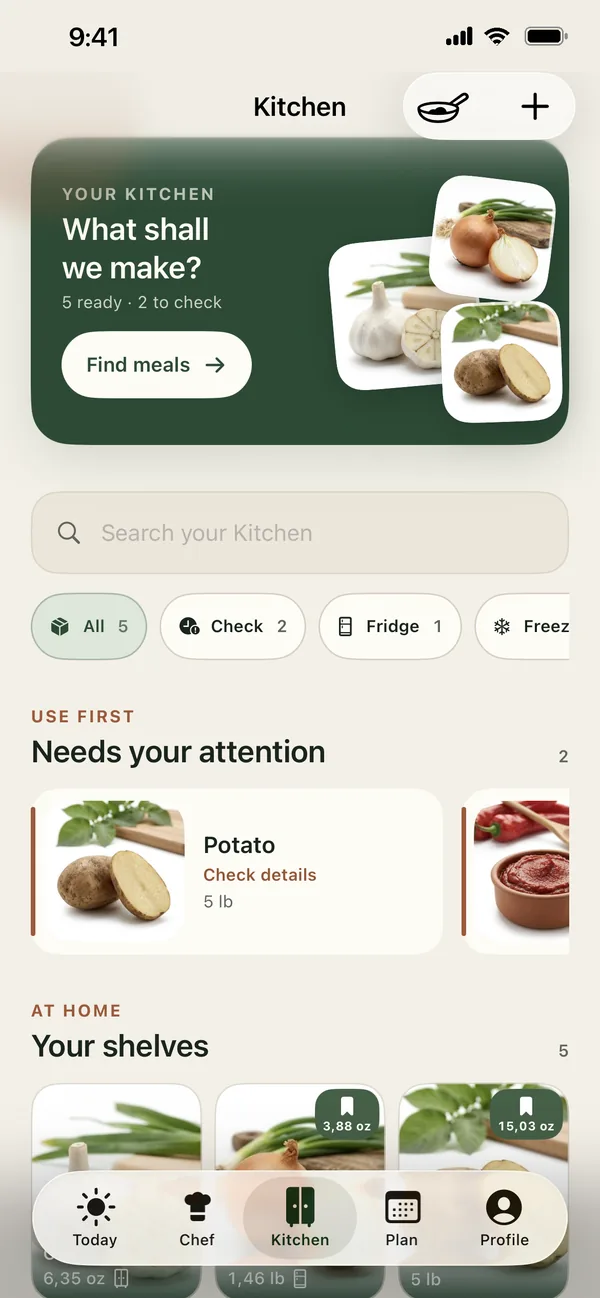
Kitchen in PantryWeave keeps the fridge, the freezer and the pantry apart, and it stays current: mark a meal as cooked and choose whether the app deducts its ingredients from your stock or keeps Kitchen unchanged.
A suggested place for every item
Kitchen suggests where each item is stored and, for items with freshness tracking, when to use it; you can change both. Tick what you buy and move it into Kitchen; you correct an amount only if it differs from the list.
See what needs using soon
For items with freshness tracking, the app suggests a day to use them by, based on where they are stored, and the Use first shelf shows which items need eating soon.
Why frozen cabbage is not for coleslaw
The NCHFP lists cabbage among the foods that do not freeze well when they are meant for a raw salad. After thawing it is limp and water-logged, and it quickly develops an oxidized color, aroma and flavor. The NCHFP’s freezing page says frozen cabbage is suitable for use only as a cooked vegetable. Use it in soups, stews or other cooked dishes.
There is one exception in the NCHFP list: cabbage can be frozen as a marinated product such as freezer slaw. It does not have the same texture as regular slaw.
How long frozen cabbage keeps
The NCHFP has no separate time for cabbage. Its general figure for fruits and vegetables prepared and packaged correctly, about 8 to 12 months at 0 °F (−18 °C), is in the chart above; for best quality, use the shorter time.
Cooking cabbage from frozen
The NCHFP says most frozen vegetables should be cooked without thawing first, so add frozen cabbage straight to the pan or pot. For freezer bags, airtight packing and other foods, see how to freeze food and prevent freezer burn; celery follows a similar method, in can you freeze celery.
Where the information comes from
Read on November 15, 2026. Most of the NCHFP pages below are taken or adapted from So Easy to Preserve, 6th edition, 2014 (Bulletin 989, Cooperative Extension Service, the University of Georgia).
- National Center for Home Food Preservation: freezing cabbage or Chinese cabbage (cooked vegetable only, cutting, blanching, headspace)
- National Center for Home Food Preservation: blanching times (shredded cabbage or Chinese cabbage, 1½ minutes)
- National Center for Home Food Preservation: foods that do not freeze well (cabbage as a raw salad; freezer slaw)
- National Center for Home Food Preservation: how long can I store frozen foods (fruits and vegetables, 8 to 12 months; what blanching does)
- National Center for Home Food Preservation: thawing and preparing foods for serving (cooking vegetables without thawing)
Frequently asked questions
Can you freeze raw cabbage without blanching it?
Not by the method of the National Center for Home Food Preservation (NCHFP). It blanches cabbage in boiling water for 1½ minutes before packing and says to always follow the recommended blanching times. Blanching stops the enzyme actions that cause loss of flavor, color, texture and nutrients, even in frozen storage.
Can you freeze coleslaw?
Not as ordinary coleslaw. The NCHFP lists cabbage among the foods that do not freeze well as a raw salad. It notes that cabbage can be frozen as a marinated product such as freezer slaw, which does not have the same texture as regular slaw.
Can you freeze Chinese cabbage?
Yes. The NCHFP gives the same method for cabbage and Chinese cabbage: shreds, thin wedges or separate leaves, blanched for 1½ minutes and used as a cooked vegetable.
How long does frozen cabbage last?
The NCHFP gives fruits and vegetables in general about 8 to 12 months at 0 °F (−18 °C); it has no separate time for cabbage. These are best-quality times; for the best result, use the shorter one.
Related guides

See what is in your freezer
Download PantryWeave and keep the fridge, freezer and pantry in one Kitchen, with a Use first shelf for what needs eating soon.

Free to start · iPhone