
Are oats gluten-free?
Are oats gluten-free? Below: what the NHS says about oats, contamination and avenin, what the FDA says about oats labeled gluten-free and cross-contact, what NIDDK says, and what a gluten-free label means, with each agency named.

Short answer: The NHS says: “Oats do not contain gluten, but many people with coeliac disease avoid eating them because they can become contaminated with other cereals that contain gluten.” It also says: “There's also some evidence to suggest that a very small number of people may still be sensitive to products that are gluten-free and do not contain contaminated oats. This is because oats contain a protein called avenin, which is suitable for most people with coeliac disease but may trigger symptoms in a few people.” It also says: “If, after discussing this with your healthcare professional, you want to include oats in your diet, check the oats are pure and that there's no possibility of contamination with gluten. Avoid oats or oat products that are not labelled gluten-free.” NIDDK says: “Talk with your doctor or a registered dietitian about whether you should include oats in your diet and how much.” It also says: “If you do eat oats, make sure they are gluten-free.”
What does the NHS say about oats?
The NHS says: “Oats do not contain gluten, but many people with coeliac disease avoid eating them because they can become contaminated with other cereals that contain gluten.”
It also says: “There's also some evidence to suggest that a very small number of people may still be sensitive to products that are gluten-free and do not contain contaminated oats. This is because oats contain a protein called avenin, which is suitable for most people with coeliac disease but may trigger symptoms in a few people.”
It also says: “If, after discussing this with your healthcare professional, you want to include oats in your diet, check the oats are pure and that there's no possibility of contamination with gluten. Avoid oats or oat products that are not labelled gluten-free.”
Can oats be labeled gluten-free?
The FDA’s questions and answers on its gluten-free labeling rule ask: “Do oats have to be certified as “gluten-free’ to be labeled "gluten-free"?” The FDA answers: “No. However, as with any other non-gluten-containing grain, oats that are labeled "gluten-free" must contain less than 20 ppm gluten.”
The FDA’s questions and answers also ask: “Can grains such as rice, buckwheat, or oats be labeled "gluten-free"?” The FDA says: “Any grain other than the gluten-containing grains of wheat, rye, barley, or their crossbred hybrids like triticale can be labeled "gluten-free" if the presence of any unavoidable gluten due to cross-contact situations is less than 20 ppm.”
The FDA’s questions and answers also ask: “What does gluten cross-contact mean in the context of the gluten-free labeling regulation at 21 CFR 101.91?” The FDA answers: “While not defined in the regulation, cross-contact, in the context of § 101.91, generally refers to the unavoidable presence of gluten in a food due to contact with a gluten-containing food (wheat, rye, barley, or their crossbred hybrids like triticale). The U.S. Grain Standards allow commodity grains, legumes, and seeds to contain a small percentage of another commodity grain as a result of commingling during production. The presence of gluten in a grain, legume, or seed that is naturally free of gluten from this type of commingling is an example of cross-contact. The typical practice of crop rotation, as well as the shared use of harvesting and transport equipment and storage silos, often results in gluten-containing grains coming into contact with other grains, legumes, and seeds that are naturally free of gluten. Furthermore, manufacturing facilities that use shared production equipment to produce foods both with and without gluten could result in gluten cross-contact. Any grain other than the gluten-containing grains of wheat, rye, barley, or their crossbred hybrids like triticale can be labeled "gluten-free" if it meets the definition, including that the presence of any unavoidable gluten due to cross-contact situations is less than 20 ppm.”
What does NIDDK say about oats?
NIDDK says: “Talk with your doctor or a registered dietitian about whether you should include oats in your diet and how much.” It also says: “If you do eat oats, make sure they are gluten-free.”
What does “gluten-free” on a label mean?
In the United States, “gluten-free” is a voluntary claim defined by the FDA. Under the FDA’s rule, a food may carry it when it is “inherently gluten free”, in the FDA’s words, or when it has no ingredient that is a gluten-containing grain, no ingredient made from such a grain that has not been processed to remove gluten, and no processed ingredient, such as wheat starch, that brings the food to 20 parts per million (ppm) of gluten or more. The FDA says the food must contain less than 20 ppm of gluten. The same rule covers “no gluten”, “free of gluten” and “without gluten”. Foods that meet the definition are not required to carry the claim, and the rule does not apply to foods whose labels are regulated by the USDA, such as meat, poultry and certain egg products.
The FDA says: “Consumers with celiac disease should read and scrutinize labels to avoid gluten ingredients.” The FDA also says: “For foods that are by nature free of gluten, but are at higher risk of gluten cross-contact (e.g., products made from grains, legumes, and seeds), the appearance of a “gluten-free” claim on the labels would provide consumers with the expectation that, if any gluten were present, it would be present at less than 20 ppm in final product. Persons with celiac disease, especially those who may be sensitive to these low levels of gluten, and persons who are otherwise sensitive to gluten should seek the advice of their health care providers for selecting appropriate foods they can consume following a gluten-free diet.”
In the UK, the NHS says that by law, food labelled gluten-free can contain no more than 20 ppm of gluten.
NIDDK says: “Your doctor or a registered dietitian can guide you on what to eat and drink to maintain a balanced diet.” It also says: “If you think you might have celiac disease, you should talk with your doctor about testing to diagnose celiac disease before you begin a gluten-free diet. If you avoid gluten before you have testing, the test results may not be accurate.”
Planning a gluten-free week is in our guide gluten-free meal plan: how to plan a week without gluten.
How PantryWeave helps with a gluten-free meal plan
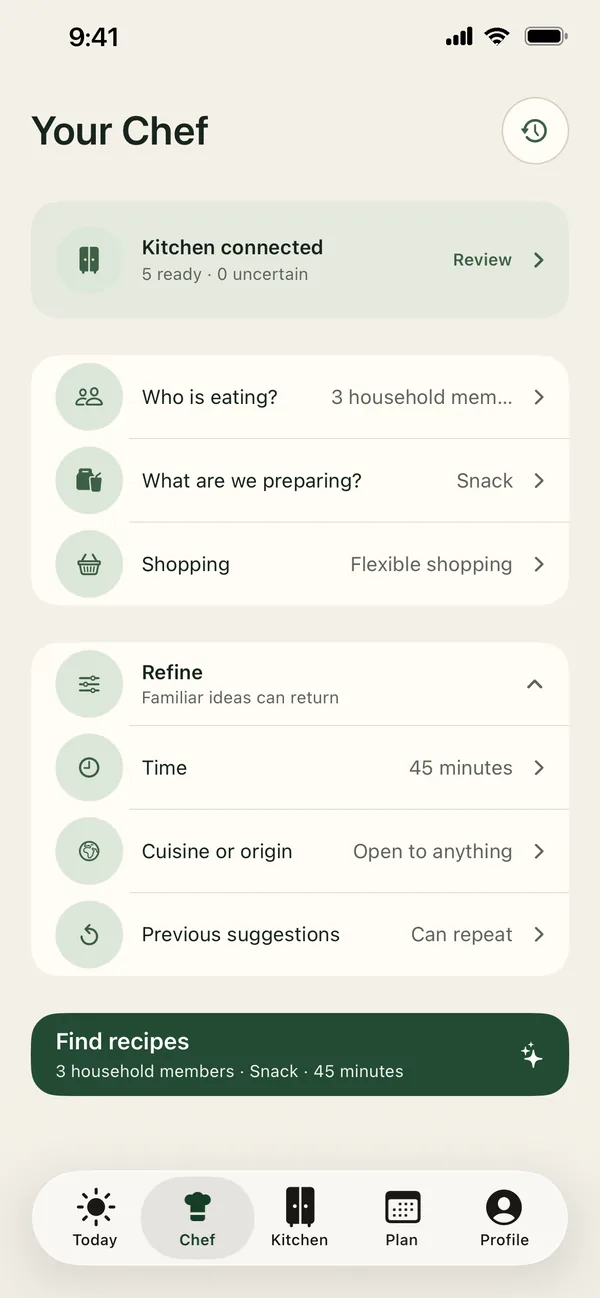
PantryWeave is a weekly meal planner for iPhone (it also runs on iPad): you plan from what you already have, and the grocery list holds only what is missing.
Wheat / gluten as an allergen
Each person’s profile has 13 allergen groups. Select Wheat / gluten for each person who avoids it; a diet, such as vegetarian, vegan or halal, and ingredient rules sit in the same profile.
Conflicts are left out
Recipes that conflict with the allergens of the people you choose in Who is eating? are left out of the suggestions.
You choose the meals
Mark the meals you want and plan them. Missing ingredients go to the grocery list, and what is already in Kitchen is subtracted. Before you cook, the planned meal is checked again.
A label reminder where you buy
Tap an item on the shopping list to see the person and the allergen it relates to. The note ends with “Check the label and ingredient list of the product you buy.”
About gluten. PantryWeave’s profile check is informational: it compares each recipe’s known ingredients with the allergens you select. Read the label of every product you buy. NIDDK says: “Your doctor or a registered dietitian can guide you on what to eat and drink to maintain a balanced diet.” It also says: “If you think you might have celiac disease, you should talk with your doctor about testing to diagnose celiac disease before you begin a gluten-free diet. If you avoid gluten before you have testing, the test results may not be accurate.”
Where the facts come from
- NHS: coeliac disease, treatment (page last reviewed 31 March 2023; oats, contamination and avenin, 20 ppm in UK law; read on November 19, 2026)
- FDA: questions and answers on the gluten-free food labeling final rule (content current as of June 30, 2022; oats, grains such as oats, cross-contact, voluntary claim, USDA-regulated foods, label reading; read on November 19, 2026)
- NIDDK: eating, diet and nutrition for celiac disease (last reviewed October 2020; oats, testing; read on November 19, 2026)
Frequently asked questions
Are oats gluten-free?
The NHS says: “Oats do not contain gluten, but many people with coeliac disease avoid eating them because they can become contaminated with other cereals that contain gluten.” It also says: “There's also some evidence to suggest that a very small number of people may still be sensitive to products that are gluten-free and do not contain contaminated oats. This is because oats contain a protein called avenin, which is suitable for most people with coeliac disease but may trigger symptoms in a few people.” It also says: “If, after discussing this with your healthcare professional, you want to include oats in your diet, check the oats are pure and that there's no possibility of contamination with gluten. Avoid oats or oat products that are not labelled gluten-free.”
Why may some people react to oats that are not contaminated?
The NHS says: “There's also some evidence to suggest that a very small number of people may still be sensitive to products that are gluten-free and do not contain contaminated oats. This is because oats contain a protein called avenin, which is suitable for most people with coeliac disease but may trigger symptoms in a few people.”
Do oats have to be certified to be labeled gluten-free?
The FDA answers: “No. However, as with any other non-gluten-containing grain, oats that are labeled "gluten-free" must contain less than 20 ppm gluten.”
What does NIDDK say about oats?
NIDDK says: “Talk with your doctor or a registered dietitian about whether you should include oats in your diet and how much.” It also says: “If you do eat oats, make sure they are gluten-free.”
Related guides

Plan your week with Wheat / gluten in each profile
Download PantryWeave on the App Store, select Wheat / gluten in each profile that needs it, plan your first week and read the label of every packaged food you buy.

Free to start · iPhone