
TDEE calculator: total daily energy expenditure for adults
This TDEE calculator estimates your total daily energy expenditure in kcal from your sex, age, height and weight, at each of the four activity levels in the 2023 National Academies report on energy. For adults aged 19 and over.

Short answer: TDEE, total daily energy expenditure, is the energy your body uses in a day, in kcal. With the 2023 National Academies equations, a 22-year-old woman who is 165 cm tall and weighs 63 kg uses about 2,275 kcal a day if she is low active, 2,112 if inactive, 2,413 if active and 2,645 if very active.
TDEE calculator
Choose metric or US units, enter your details and press Calculate. You get one estimate for each activity level. The calculator works in your browser.
Form inputs may be collected based on your analytics choices.
The calculator needs JavaScript in your browser. The equations below give the same numbers.
Your estimate appears here.
| Activity level | PAL range | Estimated TDEE a day |
|---|
What TDEE is: BMR, food and activity
Total daily energy expenditure has three parts, according to the National Academies report: your basal metabolic rate (BMR), the thermic effect of food, and physical activity.
- BMR is the energy your body needs at complete physical, mental and digestive rest.
- The thermic effect of food is generally accepted to be about 10 percent of TDEE.
- Physical activity takes the rest: the energy used in physical activity is TDEE minus BMR and the thermic effect of food.
The report expresses activity as the physical activity level, or PAL: TDEE divided by BMR. A PAL of 1.6 means your TDEE is 1.6 times your BMR.
The four activity levels
The report's equations for adults use four activity levels, each a range of PAL. It describes PAL as depending on your work, how you get around, your free time, your sleep and your surroundings. The calculator shows a result for all four levels, so you can read the row that fits your usual day. The example is the report's own: a 22-year-old woman, 165 cm, 63 kg.
| Activity level and PAL range | What it covers | Example: woman, 22, 165 cm, 63 kg |
|---|---|---|
| Inactive PAL 1.00 to under 1.53 | Basal metabolism, the thermic effect of food and the minimal activity needed to live independently | 2,112 kcal |
| Low active PAL 1.53 to under 1.68 | More walking and moving about than that, with some activity at work or in your free time | 2,275 kcal |
| Active PAL 1.68 to under 1.85 | Even more walking and moving about, with activity at work or in your free time | 2,413 kcal |
| Very active PAL 1.85 to under 2.50 | The demands of daily living plus vigorous exertion at work or in your free time | 2,645 kcal |
The TDEE equations for adults
These are the National Academies 2023 equations for adults aged 19 and over (Table S-1). Age is in years, height in centimeters, weight in kilograms, and the result is in kcal a day.
| Activity level | Women | Men |
|---|---|---|
| Inactive | 584.90 − 7.01 × age + 5.72 × height + 11.71 × weight | 753.07 − 10.83 × age + 6.50 × height + 14.10 × weight |
| Low active | 575.77 − 7.01 × age + 6.60 × height + 12.14 × weight | 581.47 − 10.83 × age + 8.30 × height + 14.94 × weight |
| Active | 710.25 − 7.01 × age + 6.54 × height + 12.34 × weight | 1,004.82 − 10.83 × age + 6.52 × height + 15.91 × weight |
| Very active | 511.83 − 7.01 × age + 9.07 × height + 12.56 × weight | −517.88 − 10.83 × age + 15.61 × height + 19.11 × weight |
A worked example
The report works through one case: a 22-year-old woman who is 165 cm tall, weighs 63 kg and is low active. 575.77 − (7.01 × 22) + (6.60 × 165) + (12.14 × 63) = 575.77 − 154.22 + 1,089.0 + 764.82 = 2,275 kcal a day.
How close the estimate is
The equations give the average for people with the same sex, age, height, weight and activity level. Real needs vary around that average. For these equations the report gives a root-mean-square error of 246 kcal a day for women and 339 kcal a day for men.
For adults whose weight is stable, the report sets the Estimated Energy Requirement equal to total energy expenditure.
Who the calculator is for
It uses the report's equations for adults aged 19 and over. The report has separate equations for children and teenagers (Table S-2), for the second and third trimesters of pregnancy (Table S-4) and for exclusive breastfeeding in the first six months (Table S-5); this calculator does not include them.
This calculator gives a general estimate and is not medical advice. For a personal energy target, ask your doctor or a registered dietitian.
US units
Heights in feet and inches and weights in pounds are converted before the equation runs: 1 inch is 2.54 cm and 1 pound is 0.45359237 kg, the exact values in NIST Handbook 44.
Nutrition per serving in PantryWeave
To see how calories per serving help when you plan the week, read about our healthy meal planner.
On every recipe
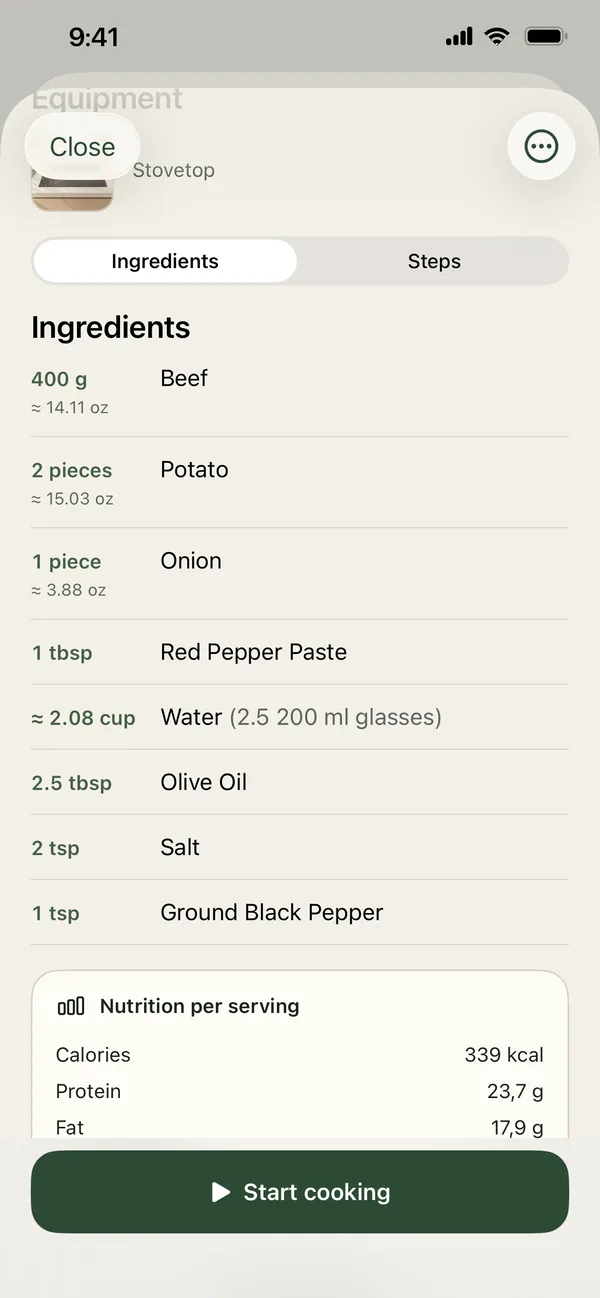
Every recipe shows its calories per serving, so you can pick meals with calories in mind.
Protein, carbs and fat
Recipes show estimated nutrition per serving: calories, protein, carbohydrates and fat.
Your week, day by day
Pick the recipes you want and tap Add to Plan: the week is laid out day by day and meal by meal, and the ingredients each meal needs are set aside in your Kitchen.
Only what is missing
The grocery list holds only what is missing. In the store you adjust the amounts you bought and move them straight into your Kitchen.
Where the numbers come from
- National Academies of Sciences, Engineering, and Medicine (2023): Dietary Reference Intakes for Energy (the equations in Table S-1, the activity levels in Table 5-4 and their descriptions, the worked example and the error figures; read on November 13, 2026)
- NIST Handbook 44 (2026), Appendix C (the inch and the pound in metric units; read on November 12, 2026)
Frequently asked questions
What is TDEE?
TDEE, total daily energy expenditure, is the energy your body uses in a day, in kilocalories (kcal). It is made up of your basal metabolic rate (BMR), the thermic effect of food and the energy used in physical activity.
How is TDEE calculated?
This calculator uses the prediction equations in the 2023 National Academies report on energy: one equation for each sex and each of four activity levels, from age, height in centimeters and weight in kilograms. For a 22-year-old woman who is 165 cm tall, weighs 63 kg and is low active, the equation gives 2,275 kcal a day.
What is the difference between BMR and TDEE?
BMR, basal metabolic rate, is the energy your body needs at complete physical, mental and digestive rest. TDEE adds the thermic effect of food and the energy used in physical activity, so it is higher than BMR. The ratio of TDEE to BMR is called the physical activity level, or PAL.
Is TDEE the same as maintenance calories?
Yes, for adults whose weight is stable. The report defines the Estimated Energy Requirement as the average energy intake predicted to maintain energy balance, and for weight-stable adults it sets that requirement equal to total energy expenditure.
How accurate is a TDEE calculator?
It gives an average for people with your age, height, weight and activity level. For these equations the report gives a root-mean-square error of 246 kcal a day for women and 339 kcal a day for men, and individual needs vary around the estimate.
Does PantryWeave show calories?
Every recipe already shows its estimated calories per serving, along with protein, carbohydrates and fat, so you can plan your meals with calories in view.
Related guides

See the calories on every recipe
Download PantryWeave and plan meals with their nutrition per serving in view.

Free to start · iPhone